
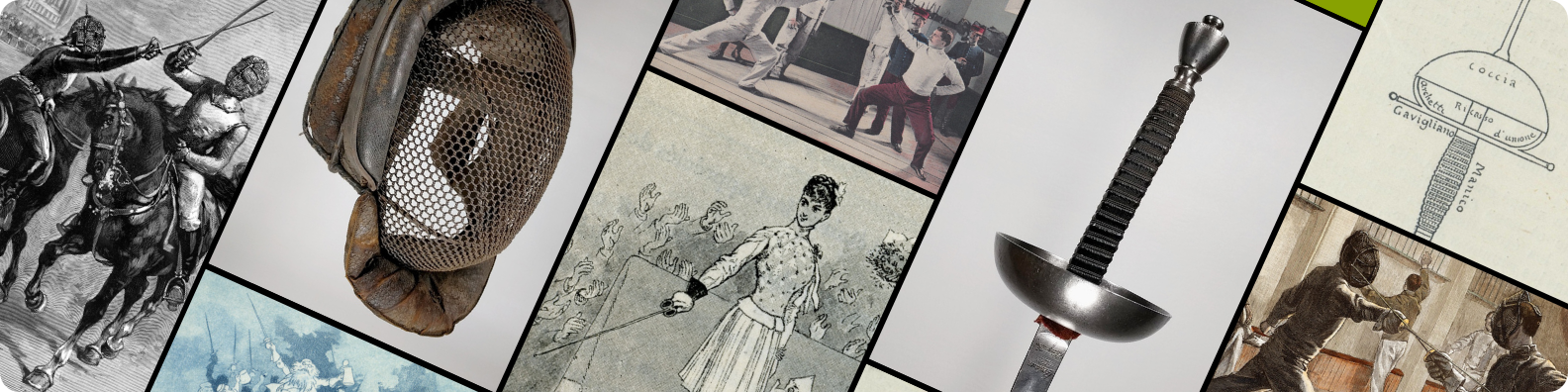
Fencing Arms & Artifacts
An online museum and research database dedicated to preserving, organising, and connecting the history of fencing. By combining digitised archives with large-scale indexing, OCR transcription, AI-assisted summarisation, and linked metadata, the collection transforms thousands of historical documents into a searchable knowledge base for researchers, historians, collectors, and fencing enthusiasts.
Building a Searchable History of Fencing
A vast amount of fencing history has already been digitised by national libraries, archives, universities, and other cultural institutions. However, these collections are dispersed across hundreds of repositories, each with its own search interface and catalogue structure. Valuable fencing material is often difficult to discover unless researchers already know where to look.
Even when historical magazines and newspapers have been digitised, they are rarely indexed beyond basic bibliographic information. Individual articles are not catalogued, people and events are seldom identified, and full-text transcriptions, if available at all, are often of insufficient quality for reliable searching. As a result, important information remains effectively hidden within thousands of scanned pages and among millions of unrelated records.
Fencing Arms & Artifacts brings these scattered resources together into a single, fencing-specific research database. Publications are indexed article by article and enriched with structured metadata, AI-generated summaries, and high-quality full-text transcriptions. By making both the metadata and transcribed text searchable, the project enables researchers to discover historical fencing information within the database and through ordinary web searches.
Connecting Information & Creating Knowledge
As the collection grows, patterns begin to emerge that are impossible to see within individual publications. The same people, competitions, clubs, manufacturers, techniques, and ideas recur across decades of magazines, books, catalogues, and photographs. Bringing these references together reveals connections that would otherwise remain hidden.
One of the long-term goals of Fencing Arms & Artifacts is to develop the world's first comprehensive subject vocabulary dedicated to fencing. Rather than relying on broad categories such as foil fencing or sabre fencing, the collection aims to describe the sport in far greater detail, identifying where subject headings are needed to cover iconic fencers, organisations, competitions, manufacturers, and recurring editorial themes. For example, subject headings for Bayonet Fencing, Italo Santelli, New York Athletic Club, Amateur Fencers League of America, or Health Aspects of Fencing.
By developing and applying controlled subjects consistently across the collection, information from thousands of independent sources can be connected into a single network of knowledge. Researchers will be able to discover not only individual documents, but also the people, ideas, events, and the evolution of the sport itself.
Support the Project
Fencing Arms & Artifacts is an independent, community-supported project. Every contribution helps cover the ongoing costs of hosting, storage, domain registration, and the computing resources required to process and preserve an ever-growing collection of historical material.
If you find the database valuable, consider becoming a patron. Your support helps ensure that this resource continues to grow and remains freely available to researchers, collectors, fencers, and historians for years to come.