-
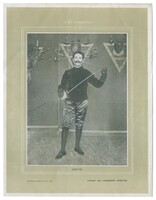 Portrait of Maitre d'Armes Conte
A portrait of Maitre d'Armes Conte holding a sabre in the sport magazine La Vie au Grande Air - Sports Celebrities Gallery. A supplement to the February 4, 1904 issue.
-
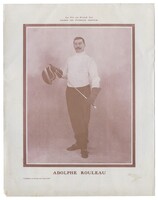 Portrait of Adolphe Rouleau
, part of the Galerie Des Célébrités Sportives series. Supplement to the June 2, 1905 edition of La Vie au Grand Air.
-
 Notice sur l'Ecole Supérieure d'Education Physique de Joinville-le-Pont : Historique, Role et Fonctionnement (1852-1930)
Provides a detailed historical account of the École de Joinville, a prominent French institution focused on physical education, founded in 1852. The document outlines the school's evolution, from its early days under the Ministry of War, through various periods of innovation and reform, influenced by figures like Amoros, Marey, Lagrange, and Demeny. It highlights Joinville's role in shaping physical education practices not just in the military, but across France, impacting both civilian and military education systems. The text emphasizes the school's scientific approach, particularly its contributions to physiology and mechanics applied to physical training. Additionally, it mentions the influence of various foreign systems, such as the Swedish gymnastics method, and how Joinville integrated and adapted these influences over time. The document also touches on Joinville's role during World War I, where it adapted its methods to meet the urgent needs of the military.
-
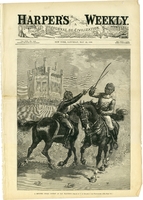 Mounted Sword Contest in San Francisco
Front page of May 22, 1886 Harper's Weekly with illustration drawn by "T de Thulstrup" of a mounted sword contest in San Francisco. The illustration depicts two fencers with sabres on horseback with the Telegraph Hill Observatory (also called Layman’s Castle) in the background. An original photograph which may have been the inspiration for this illustration exists in the park archives of the Golden Gate National Recreation Area in San Francisco.
-
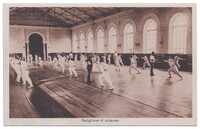 Modena Infantry and Calvary Academy Postcard
Postcard with photograph of the fencing pavilion at the Regia Accademia di Fanteria e Cavalleria (Royal Infantry and Cavalry Academy) in Modena, Italy. In the large pavilion can be seen four rows of fencers practicing with fencing sabres. Two instructors can be seen in the foreground giving lessons. One is dressed in all black and the other in the usual white fencing attire but with black pants.
-
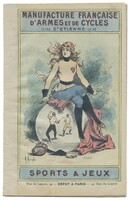 Manufacture Francaise d'Armes et de Cycles
Sales catalog from the Manufacture Francaise d'Armes et Cycles in Saint Etienne, France. Features sporting equipment for gymnastics, exercise, fencing, skiing, skating, hiking, archery, croquet, and tennis.
Also includes an article discussing fencing as a hobby, the health benefits of taking up the sport, and commentary on the ongoing, contemporary debate between the merits of epee versus foil fencing. Other sporting articles on croquet, lawn-tennis, rugby, and skating.
Seller indicated the date upon acquisition. Binding suggests the catalog may have been cut from a larger volume. No printed date is found in the catalog.
-
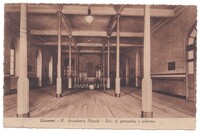 Livorno Naval Academy Sala di Scherma
Postcard with a photograph of the gymnastics and fencing room (sala di ginnastica e scherma) at the Accademia Navale in Livorno, Italy.
-
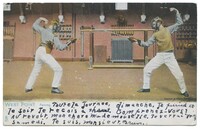 Life at West Point - Fencing
Postcard sent on September 21, 1909 addressed to Miss Embry, French Instructor, in Institute, West Virginia. Front depicts two West Point cadets wearing plastrons, masks, and fencing gloves and practicing or fencing with foils. Indian clubs and other gymnastic equipment can be seen in the background. This postcard is no. 2322 of a series and is titled "Life at West Point" with this description:
"Fencing, supplemented by single stick exercise and sabre duelling, constitutes one of the principal branches of gymnasium work at the Academy. It is especially desirable for a military officer, who, despite the waning use of the sword in all modern armies, may at any time be called upon to defend himself with an edged weapon."
On the face is a note in French to the adressee:
"Tout le journée, dimanche, je pairied [sic] et le soir je recois a th??et. Comprenez-vous? Au revoir, mon chere Mademouselle [sic]. Te verrai vous samedi. Te suis, monsieur, ????.
-
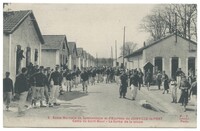 Leaving the Dining Hall
Postcard with photograph from the Ecole Normale Militaire de Gymnastique et d'Escrime at Joinville-le-Pont. Soldiers in uniform walk through the streets of Camp de Saint-Maur after a meal.
-
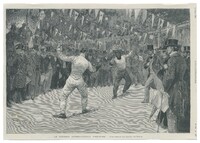 Le Tournoi International d'Escrime
1896 engraving titled "Le Tournoi International d'Escrime" published in the illustrated magazine "l'Illustration." Depicts an epee bout with onlookers at an international fencing tournament in Paris. The presence of an accompanying descriptive article is unknown.
-
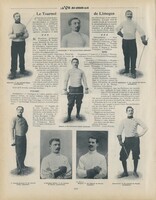 Le Tournoi de Limoges
Article on an amateur and professional fencing tournament in Limoges, France. The tournament for both foil and épée drew competitors from France, Italy, and Belgium. Controversy arose as some of the professional jury's decisions led to protests and withdrawals, but was ameliorated when Baron d'Ezpeleta, a well known fencer, took over direction of the jury.
-
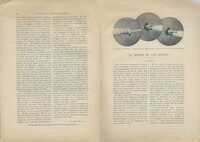 Le Monde et Les Sports - l'Épée
1901 article by Ernst Nomis describing the rationale and merits of the newly-introduced épée fencing in contrast to foil fencing. Contains some technical descriptions of maneuvers and techniques with photographs of Spinnewyn, head of Salle Spinnewyn and the Circle d’Escrime Épée.
-
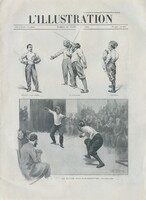 Le Match Pini-Kirchhoffer
Cover article recounting the renowned fencing competition between the popular fencing masters Pini and Kirchhoffer of the Italian and French schools, respectively.
The competition occurred over three days and at two different locations. The first day of competition was held on a Tuesday at the Grand Hotel, continued at the "Sociétés Savantes" on Wednesday, and finished back at the Grand Hotel on Thursday.
By the conclusion of the competition, Kirchhoffer had made 24 touches against Pini and received 22 himself. The results and outcome was, according to the author, not the competition organizer's priority which was instead celebrating "the glory of the arms."
-
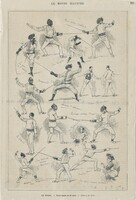 Le Grand Assaut du 26 Mars
Drawings of individual fencers and assaults at the Grand Assault of Arms on March 26th, 1882. This page was separated from remainder of the periodical; the transcript of the accompanying article was found in the Bibliothèque nationale de France (see relations).
-
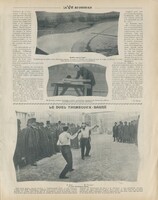 Le Duel Thomeguex-Barré
Notice of a duel between Monsieur Thomeguex, a well-known amateur and Barré, a left-handed fencing master. The duel was led by Monsieur Breittmayer. After thirty-five minutes with no result, Mr. Breittmayer appealed to the two opponents attempting to put an end to the duel. Both duelists approved and reconciliation was made.
-
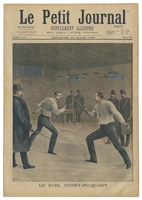 Le duel Henry-Picquart
The duel between Colonel Henry and Lieutenant-Colonel Picquart occurred following a confrontation during the Zola trial. Colonel Henry had publicly contradicted Picquart, who responded by challenging Henry to a duel. Initially, Henry expressed a desire to resolve certain matters before proceeding but eventually agreed to the duel. The duel took place at the École Militaire, where Henry sustained a wound to his arm.
-
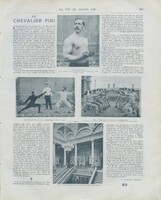 Le Chevalier Pini
A feature on the Italian fencer, Pini, whom the author, Gustave de Lafreté, credits with helping to popularize the sport. Describing Pini as having the flexibility, speed, and strength of a panther, de Lafreté covers Pini’s achievements as an athlete and teacher. The article features photographs of the Jockey-Club in Buenos-Aires, which Pini helped to establish. De Lafreté reports Pini’s plans for the following year (1900) to bring a team of 20 civilian and military fencing students to Paris to challenge 20 French amateurs in a series of assaults that the author says are sure to be promising.
-
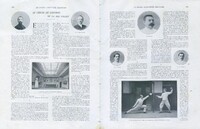 Le Cercle d'Escrime de la Rue Volney
The author discusses the new salle d’armes of the Cercle de l’Escrime, soon to open on rue Volney in Paris. Founded in 1883, the Cercle de l’Escrime established its first salle d’armes on rue Taitbout, where, among others, renowned master Hottelet, journalist Adolphe Tavernier, and fencer Georges Breittmayer helped to make the salle a premier fencing establishment in Paris. Carrying on this legacy, the new salle d’armes, led by master Midelair and young masters Pierre Gallet and A. Coubard, will host international events featuring the best fencers at home and abroad.
-
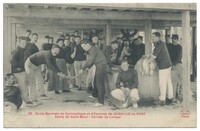 Laundry at Joinville
Postcard with photograph from the Ecole Normale Militaire de Gymnastique et d'Escrime at Joinville-le-Pont. A group of soldiers on laundry duty pose for a photo as two men in the foreground wring out a wet garment.
-
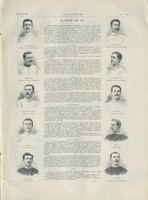 La Soirée des Dix
Profiles on ten participating martial artists at evening of public assaults and/or demonstrations organized by the Journal des Sports. For the five martial arts on display (foil fencing, épée fencing, French boxing, English boxing, and baton) two participants were chosen in each field. For foil, Kirchhoffer and Adolphe Rouleau were chosen, and for épée M.W. de Blest-Gana and Spinnewyn.
The assessment of the fencers was written by an authoritative critic, possibly a sports journalist knowledgable in fencing. This is on account of the writer's ability to describe not only the technical capabilities of each fencer, but also each fencer's approach, expression, temperament, and character both on and off the piste.
The name of this critic is unknown, but they may have been known under the pen name "Rapière."
-
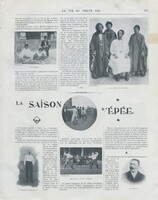 La Saison d'Épée
Season summary of fencing meetings and competitions mainly in French provincial cities (Lyon, Lille, Dijon, Bordeaux, Evian, Longjumeau, Étretat, Langrune, Tréport, Paramé, Boulogne, and Saint-Malo) but also in Ostend (Belgium) and London (England).
-
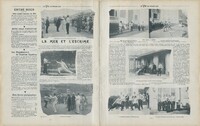 La Mer et l'Escrime
Article describing the popularity of fencing festivals, tournaments, and lessons organized seaside in ten different French coastal towns.
-
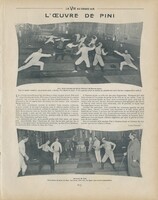 l'Oeuvre de Pini
Illustrated newspaper article on the return of Italian fencing master Pini to Paris, and about his acclaim and school in Buenos Aries, Argentina.
-
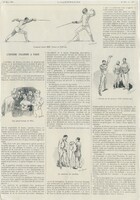 l'Escrime Italienne a Paris
Illustrated article on the reception of Italian fencing and Italian fencing masters in France. Also provides commentary on the state of fencing and the rivalry between the Italian and French School.
-
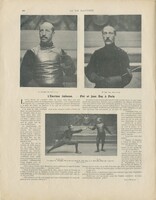 l'Escrime Italienne - Pini et Juan Bay a Paris
An article on Maestro Pini's visit to Paris and an interview with his student, Juan Bay.
