-
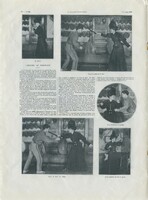 l'Escrime au Parapluie
Newspaper article with photographs describing the use of an umbrella for self defense. Techniques created by the Institute for Physical Culture in Philadelphia in response to increasing robbery of women. The cause of the increase, the author claims, is financial hardship in the United States, which is likely a reference to the Panic of 1901, 1907, or both. Describes and depicts the guard position as well as four techniques.
-
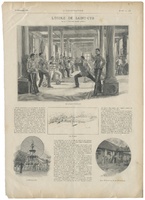 L'Ecole de Saint-Cyr
Newspaper article with illustration depicting the salle d'armes at the École spéciale militaire de Saint-Cyr.
-
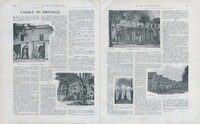 l'Ecole de Joinville
First of a two-part article on the fencing & gymnastics school at Joinville (Ecole Normale Militaire de Gymnastique et d'Escrime). Describes the ancestors to the school, its formation into its final form, the command structure, and its initial commanding officers. The article proceeds to specific details of the Gymnastics Division including its instructors, students and accolades.
-
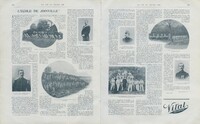 l'Ecole de Joinville
Second of a two-part article on the fencing & gymnastics school at Joinville (Ecole Normale Militaire de Gymnastique et d'Escrime). Finishes where the previous article left off concerning the gymnastics division then details the fencing division's location and facilities, instructors, the system of promotion, and some of the notable accolades by the students.
-
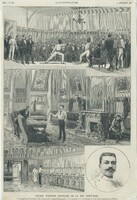 l'Ecole d'Escrime Française de la Rue Saint-Marc
Four combined engravings by E.A. Tilly depicting the fencing school facilities on rue Saint-Marc, Paris, and Monsieur Rüe, the professor of the school. The top image depicts the salle d'armes during a public assault on December 8, 1887, with Messieurs Rue and L'Angle-Beaumanoir at assault with foils. Below the assault is the salon with school members at rest, and at bottom is the dressing and wash room.
This page was separated from remainder of the periodical; existence of accompanying article is unknown.
-
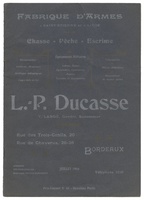 L. P. Ducasse Catalog
Catalog of sale for L. P. Ducasse containing items for hunting, fishing, and fencing.
-
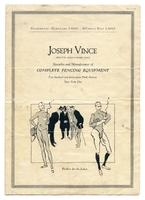 Joseph Vince Fencing Equipment Catalog
Bifold catalog of fencing equipment including illustrations of weapons, protective equipment, and accessories. Complete price list for all products and components on rear cover.
-
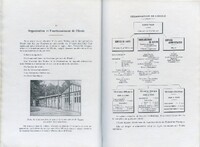 IV. Organisation et Fonctionnement de l'École
This chapter from "Notice sur l'École Supérieure d'Éducation Physique de Joinville-le-Pont" by Lieutenant-Colonel Labrosse describes the organizational structure and operational procedures of the École Supérieure d'Éducation Physique de Joinville. The school is organized under military command, with divisions responsible for instruction, administration, health services, and specialized training. The chapter includes details on the personnel, which comprises both military and civilian staff, and the various courses and stages offered by the school. The school’s direct affiliation with the Ministry of Physical Education and its integration of modern educational techniques are also emphasized.
-
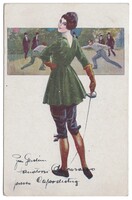 Italian Postcard of a Woman and a Duel
Italian postcard depicting a glamorous woman holding a mixed school (scuola mista) fencing sword. Inset behind her is a a dueling scene with two combatants and their seconds.
-
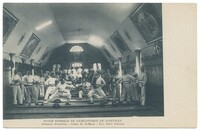 Inside a Salle d'Armes at Joinville
Postcard with photograph of fencers receiving instruction inside a Salle d’armes at Ecole Normale Militaire de Gymnastique et d'Escrime.
-
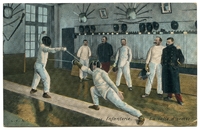 Infantry Fencing School Postcard
French postcard depicting a fencing school, likely École Spéciale Militaire de Saint-Cyr due to the "Infanterie" title and the uniforms worn by two of the men in the image, particularly the red pants which were worn by students and graduates of Saint-Cyr.
-
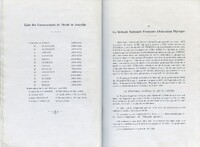 III. la Méthode Nationale Française d'Education Physique
This chapter from "Notice sur l'École Supérieure d'Éducation Physique de Joinville-le-Pont" by Lieutenant-Colonel Labrosse discusses the development and refinement of the French National Method of Physical Education, a system that integrates various physical training techniques from both French and foreign influences. The method emphasizes a comprehensive approach to physical education, starting with basic exercises for children and advancing to complex athletic training for adults. The chapter details how the method has been shaped by scientific research and practical experience, particularly during the interwar period, and how it has been codified in the 1927 General Regulations. The method’s adaptability and focus on individual needs are highlighted as key strengths.
-
 II. Historique
This chapter from "Notice sur l'École Supérieure d'Éducation Physique de Joinville-le-Pont" by Lieutenant-Colonel Labrosse provides a historical overview of the school, established in 1852, and its evolution through various military and educational reforms. It traces the school’s development from its founding by key figures influenced by Amoros, a pioneer in physical education, to its pivotal role during and after World War I. The chapter details how the school adapted to changing needs, particularly in response to the demands of national defense and public health. It also highlights the school’s contributions to the standardization and dissemination of physical education methods across France, cementing its status as a national leader in the field.
-
 I. Rôle général de l'Ecole
This chapter from "Notice sur l'École Supérieure d'Éducation Physique de Joinville-le-Pont" by Lieutenant-Colonel Labrosse outlines the primary objectives of the École Supérieure d'Éducation Physique de Joinville as established by the Ministry of War in 1912. The school's mission includes educating military officers in physical training, forming physical education instructors, and researching improvements in physical education and fencing methods. The school's role extends beyond the military, influencing national education and physical training practices throughout France. The chapter notes the school’s significant impact on both military and civilian physical education, demonstrating its comprehensive approach to physical fitness across various age groups and sectors.
-
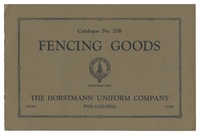 Horstmann Fencing Goods Catalogue
Fencing equipment catalogue for the Horstmann Uniform Company, located in Philadelphia, Lyons, and Paris. Catalogue numbered "25B" and features descriptions and illustrations of fencing foils, epees, sabres, and masks.
-
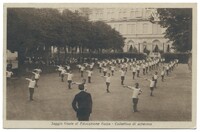 Gonzaga Institute Fencing Examination
Photo postcard depicting the fencing portion of the final physical education exam at Istituto Gonzaga, Milan, Italy. Elementary students form fourteen rows and five ranks with sabres in hand.
-
 French Foil
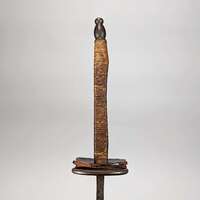
French foil with cord wrapped grip and small figure eight guard. Flared curvature of grip and peened, acorn-shaped pommel. Red Leather pad laminated with woven fabric on forward face. English-language country of origin mark "Made in Germany", "Solingen", "##" and "J. H. Lau & Co New York" markings on the blade forte.
-
 French Foil
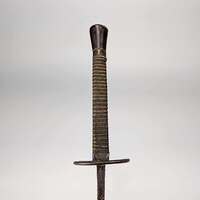
French foil with green- and ivory-colored cord-wrapped grip and iron figure eight guard. Dark brown patina on all metal parts. Peened pommel and Solingen (Germany) made blade. "Solingen" markings on top and bottom of blade near forte with the "5" mark indicating blade size. "V j B" and corner of a human head and crown in profile marked very close to the forte. A faded and incomplete mark "Acier Bede..." also marked in a font unlike the Solingen mark, and is likely "Acier Bedel" as seen on other foils.
-
 French Foil
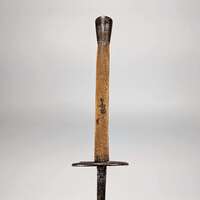
French foil with bare wood grip and figure eight guard. Solingen (Germany) made blade with "Solingen" markings on the blade and "4" mark indicating blade length. Also marked is a small crowned head in profile near the forte. Unknown if grip was previously wrapped, though wrapping was likely.
-
 Foil Mask
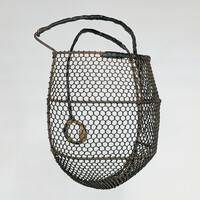
Wire mesh fencing mask similar in design to a mask depicted in the Heck Encyclopedia of 1851 (Fig. 8). Features a retaining bar across top of the head and a tongue over and behind the head. Fabric covering sewn onto the sides and top of the wire mesh mask, and wound around the retaining bar & tongue.
-
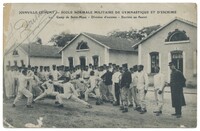 Foil Fencing at Joinville
Postcard with photograph from the Ecole Normale Militaire de Gymnastique et d'Escrime at Joinville-le-Pont. Taken at Camp de St-Maur and labeled with "Escrime au Fleuret." A crowd watches three pairs of fencers. The two fencers in for foreground are fencing foil, while the pair behind them hold sabres.
A handwritten inscription is dated 1911 from Joinville.
-
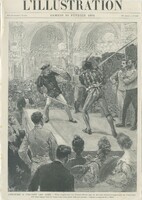 Fencing Through the Ages
Periodical cover engraving commemorating a festival organized by the Société d'Encouragement de l'Escrime celebrating fencing through the ages. Depicts two fencers in 16th century costume fencing two-handed sword versus sword and shield on a raised stage at the Grand Hotel. Cover separated from remainder of the periodical; existence of accompanying article is unknown.
-
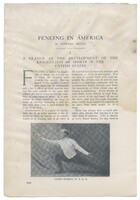 Fencing In America
First in a two-part series on fencing in America, from it's early days up to the date of publication. Includes details on notable schools, clubs, instructors and fencers as well as the Amateur Fencers League of America, the difficulties of judging bouts, and collegiate competition.
-
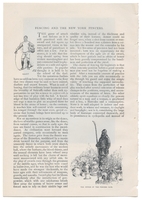 Fencing and the New York Fencers
The article discusses the history and merits of fencing, highlighting its origins through its transformation into a safe and enjoyable pastime. The article emphasizes the benefits of fencing, both as a physical exercise that equalizes individuals and as a mental discipline that promotes self-control and good spirits. It also touches upon the establishment and success of the Fencers Club in New York, a place where fencing is practiced as an athletic pursuit rather than a class-based pastime. The text concludes by asserting that fencing, with its qualities of grace, athleticism, and sportsmanship, is a fine art among athletics.
-
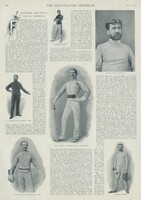 Fencers and Fencing In America
The article discusses the evolution and growing popularity of fencing in America, particularly in New York. Fencing, once a vital skill for gentlemen, has transformed into a fashionable pastime, shedding its violent connotations. The New York Fencers' Club originated from a fencing school established by Captain Hippolyte Nicolas, a French officer. Fencing gained traction despite initial skepticism, with Senac, a French maître d'armes, playing a pivotal role in popularizing it. The text highlights the diverse backgrounds of fencers, including actors and professionals, and notes the charm of perpetual youth that fencing seems to endow its practitioners with. Competitive exhibitions and championships have further fueled interest, with the Amateur Athletic Union organizing contests. The text concludes by suggesting potential changes in championship rules to foster more inclusive and representative competitions. Overall, it paints a picture of fencing as a growing and diverse sport with a rich history and increasing popularity in America, particularly in New York.
