Women's National Championships
Item
-
Title
-
Women's National Championships
-
Date
-
May 7, 1936
-
volume
-
1
-
issue
-
10
-
page start
-
1
-
page end
-
2
-
content
-
en
WOMEN'S NATIONAL CHAMPIONSHIPS
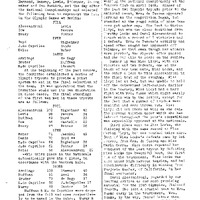
Vivacious, dark Joanna de Tuscan, of Detroit, climaxed a remarkable season by winning the national championship at the Fencers Club on April 24th. Winner of the last two Olympic tryouts prior to the national event, Mrs. de Tuscan appeared nervous as the competition began, but steadied as the round robin of nine fencers got under way. She lost to Marion Lloyd, but won two close decisions from Dorothy Locke and Carol Alessandroni to finish with a record of 7 victories and 1 defeat. Mrs. de Tuscan’s mobility and speed often caught her opponents off balance, so that even though her attacks were parried, the riposte often passed and she was able to score on the remise.
Runner-up was Miss Lloyd, with six victories and two defeats, one at the hands of her teammate, Miss Locke, and the other a loss to Miss Alessandroni in the final bout of the evening. Miss Lloyd led at 3-1, but was unable to hold off the determined left-hander. Earlier in the tourney, Miss Lloyd had a hard fight with Mrs. Funke which might easily have been won by the latter, except for the fact that a number of touches were doubtful and were thrown out. Miss Lloyd did not fence as well as she can. The nervous tension under which she has labored throughout the year’s competitions was especially apparent at the nationals.
Third place went to Miss Locke, who finished with the same record as Miss Marion Lloyd, but was touched twice more. Both of Miss Locke’s defeats came by 5-4 scores, from Mrs. de Tuscan and Miss Maria Cerra. Miss Cerra repeated her conquest of the last tryout by defeating Miss Locke in a beautiful bout, the first one of the tournament. Miss Locke was also under high nervous tension, and had considerable difficulty in winning from Marjorie Kumler, of California, in her final encounter.
Carol Alessandroni, regarded by our leading critics as our most promising material for the 1940 Olympics, finished fourth. She lost a crucial bout to Mrs. Funke early in the tournament. Mrs. Funke, by the way, fenced better than ever, although she lost her fifth place to Muriel Guggolz on touches. Both Miss Guggolz and Mrs. Funke showed excellent style and were instrumental in staging several of the best bouts of the evening.
Miss Cerra started out strongly, but weakened in the later stages. She won only two bouts, but finished ahead of Miss Kumler on touches. The blonde Californian, incidentally, gave a good account of herself in her first national tournament, carrying the best fencers in the finals to 5-4 bouts. Her game is not yet sufficiently developed to constitute a real threat to the veterans. She lacks power on the attack and sureness in the parry-riposte, but she has a marvelous physique upon which to build a strong technique.
The other finalist, Theota Land, of Cleveland, was obviously weaker than the rest. She has a long way to go before she is able to meet strong fencers on even terms.
Mrs. de Tuscan’s victory was a popular one and it was highly gratifying to her Detroit followers who arrived shortly before the finals. Among them was Detroit’s only fencing master, Joanna’s first teacher, her handsome husband, Bela de Tuscan.