-
Title
-
Men's Foil Nationals
-
Date
-
May 7, 1936
-
volume
-
1
-
issue
-
10
-
page start
-
3
-
page end
-
3
-
content
-
en
MEN’S FOIL NATIONALS
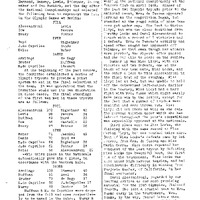
A brilliant climax to the most important national championship ever held by the A.F.L.A. was Hugh Alessandroni’s victory in the foils, last of the events on the program on April 29. Finishing the regular round robin in a tie with Joe Levis and John Huffman, the stocky Fencers Club representative regained the title he had held in 1934 by trouncing Huffman 5-0 and then going on to beat Levis for the second time 5-3.
Victory in the foil championship has always been specially significant in the fencing world, but never was it sweeter for the champion than it was this time. Hugh won in 1934 after several years of being second to Joe Levis, but in 1934 Joe was unable to fence, being stricken down by an attack of appendicitis. Then, last year, with Levis back in the running, Hugh had gone to the final bout without a defeat only to take a terrific beating at the hands of his friendly rival in the decisive bout for the championship.
This year, however, Hugh went to the final unbeaten. He faced Joe Levis and won 5-3. In the last bout of the round robin, he led John Huffman 4-2, and needed but one touch to win the title. At that point, the N.Y.A.C. stylist rallied and scored three times inside of a minute. When the final point was scored, Alessandroni apparently thought the score was 4-all and stood uncertainly on the mat. It had been the most beautiful action of the finals. Huffman attacked, and immediately after Hugh’s parry, John remised with a double and finished in opposition. The audience thundered its appreciation of this bit of technical wizardry, and it was a full minute before the applause died down sufficiently for the director to make his decision heard.
A triple tie had resulted, and on the fence-off, Alessandroni polished off his erstwhile conqueror in three minutes, and then went on to beat Levis again. We have never seen Hugh fence so truly like a champion. He was faster than ever, coordinating perfectly, and he showed the “killer” instinct in not giving his rivals a chance. He too showed masterly technique, and one of his best touches on Levis was the difficult parry in prime with a flying riposte.
Joe Levis came second by defeating Huffman again in the final bout of the evening, which came as an anti-climax. The formidable Bostonian was beaten by two men through the 2 days of fencing, and each beat him twice. Alessandroni did it in the finals, and Frank Righeimer turned the trick in the quarter and semi-final rounds. Levis turned the tables on Frank in the finals in no uncertain way.
Huffman proved again that he is now one of our very best foilsmen, and that if he should ever specialize in this weapon, he would have at least an even chance for the title. At the conclusion of the regular final, John’s only loss had been to Levis by a 5-4 score, and so was therefore only 1 touch away from the championship. This, despite the fact that Huffman had previously fenced five hard bouts in the final of the sabre. Fourth place went to Frank Righeimer, who had also done double duty in the finals, as he had fenced in the epee earlier in the evening. It was in fact the doubling up of Huffman and Righeimer that caused the foil tournament to be run last, instead of first as customary.
John Potter nosed out Darnell Every for the fifth place. Every’s first two bouts were with Levis and Alessandroni. They were spectacular and hard-fought. In fact, the bout with Levis was so long and so keenly contested that it probably wore both men down, and may have cost Levis the championship. At any rate, Every was finished after it and did not win another bout.
Prior to the final evening, the greatest upset of the tournament was the elimination of Warren Dow, metropolitan champion, at the conclusion of the semi-final. It was a heart-breaking result for Dow, who had been consistently good all year, and who stood a good third in the point standings for the Olympics. Eliminated in the same semi-final pool was Hugo Castello, intercollegiate champion for the last year. Castello rated a strong chance to qualify on the basis of his season’s performance and his fourth place in the nationals last year, but he still needs competitive experience among the top flight. In the other semi-final, Castello’s predecessors as intercollegiate champions, Hurd (’34) and Pecora (’33), were also eliminated. Bill Pecora, who had a tough time getting by the quarter-final, showed to better advantage than Hurd, and might have qualified on touches if he had been able to win from Alessandroni. Pecora led 4-1, was tied at 4-all, and then executed a beautiful riposte which, however, in the opinion of the judges, did not land with the point. The new champion scored the winning touch on the next exchange.
The tournament, which was the only truly representative national championship ever held, showed that foilsmen trained west of the Atlantic seaboard are still behind their eastern rivals in technical accomplishment. Ed Carfagno, Pacific Coast Champion, was eliminated in the quarter-final, as were Campbell Wilson and Bill Chiprin, first and second in the mid-west tournament. Of these, Wilson seems the best. He attracted favorable notice last year, and he continued to impress this year. It was he who fought Bill Pecora for the last qualifying place in the quarter-final, and lost 5-4 after a stubborn battle in which Pecora’s greater experience was the winning factor. Chiprin lacks a sensitive foil hand. Invariably, he insists on the attack after it has been parried. He needs training in the phrase d’armes, so that he may parry the riposte and score on the counter riposte. Carfagno impressed much more in the sabre than in the foil, as the cutting weapon seems better adapted to his natural ability.