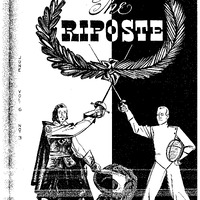
The Lesson
Item
-
Title
-
The Lesson
-
Date
-
June 1941
-
volume
-
6
-
issue
-
3
-
page start
-
16
-
page end
-
17
-
content
-
en
The Lesson
By JOHN DIMOND
U. S. Military Academy
The fencing pupil is wanting in judgment if he submits himself to the coach for a lesson, year in and year out, without some exact purpose in his own mind.
There should come a time when the pupil is aware of his needs in most departments of the game. He is likely to reap greater profit from the lesson if the lesson is shaped to his own needs and desires, as determined by his own experience. The coach does try to shape the lesson to the pupil's needs as he, the coach, understands them. But, sadly, the pupil is too often unaware of what, exactly, the coach is trying to achieve or trying to induce the pupil to achieve.
Too often the lesson is seen as the cure-all and in the effort to make of it a cure-all too many elements are woven into a disharmonious pattern.
The lesson should be simplified in that the most important element in the lesson is understood and all actions are incidental to that precise development.
Lessons can and should vary in greater or lesser degree depending upon the exact purpose. The routine lesson that is ground out, day after day, and year after year, is better than no lesson at all, but not much better.
A fencer of some little experience should know of the basic elements of fencing and in which element he most needs training.
Do you need conditioning? Ask for a lesson for that purpose.
Do you need to improve your defensive game or your parry technique?
If you ask for what you think you need, you will enjoy the lesson, gain more from it, and stimulate the coach out of the routine that you may have helped to make inevitable.
At any given moment you will have a special need. Have some idea in the matter and ask for the kind of lesson you think most profitable and satisfying.
You will probably be very happy to find so much submerged talent and knowledge in the coach.
Many fencers lucky enough to have ready access to a professional avoid lessons because they are so fatiguing and dull. This fact, if a fact, is the fault of the pupil for leaving the lesson in all of its details entirely up to the energy, imagination and judgment of the coach.
If the coach, through the years, handles pupils perforce as a coal passer handles lumps of coal, he will, naturally, perform very much like a coal passer.
The most satisfying experience short of winning a championship may well be a work-out with the coach, no matter what your fencing experience or rank, provided you are jointly working toward a specific objective.
Know what you need and ask for it. Never doubt that you will get it, because no one is more anxious to give you what you want than your fencing coach.
Giving lessons is fatiguing in the peculiar fashion that follows restriction of any sort. After a half dozen technique lessons, the coach is much more tired than the fencer who fights a like number of hard bouts. As a result, the coach is seldom in the mood or condition for a bout or free play.
One lure, used by a fencer who wished to fence with the coach, but could not enjoy the routine lesson, was to offer the coach a certain reward (monetary) for every hit the coach could score before the pupil himself scored a stated number on the coach.
If you are not fully satisfied with your coach, you might consider first if you are getting the best use out of the coach in your own behalf and interest.
The coach is not likely to resent the idea that you are "using" him. Being a fencer he will manage that matter and it will probably be a refreshing change for him, from wood-chopping, if you have, heretofore, been a blockhead in this little matter.
Pupil: "Coach, I want to improve my foot-work."
Coach: "What kind of foot-work?"
Pupil: "Just foot-work."
Consider "just foot-work" for a moment and you will find that you have given a large order, but, Lord love you, you have, at least, taken the lesson out of the grab-bag and the catch-as-catch-can class, and that is something.
The novice is best off to leave the form of the lesson to the judgment of the coach, but the fencer of some experience should use his experience when seeking to improve his game with the aid and advice of a coach.
Ask. You'll get it!