-
Title
-
Six Years of the Riposte
-
Date
-
December 1941
-
volume
-
6
-
issue
-
5
-
pages
-
1-2, 16
-
content
-
en
SIX YEARS OF THE RIPOSTE
By Jose R. de Capriles
—
With William A. Perry, III, Jose de Capriles founded the Riposte in 1935. They have kept it alive and occasionally prospering for six years--longer than any other American fencing magazine. How it managed to survive and grow constructively is explained by the founder.
—
WELL, the brat is six years old this month and refuses to be called baby any more—it has begun to show signs of being an up-and-coming young man. In the course of its growth it has acquired a godfather and numerous aunts and uncles who are mighty proud of this youngster and feel that the hundreds of friends it has made during its young life, friends who have been so instrumental in molding its character, would like to join us in our reminiscence of the past six years.
In November of 1935, Bill Perry and I felt that a news medium was sorely needed in fencing. We had watched others bring forth magazines on a grand scale. The latest attempt had been particularly impressive. It had been given everything money could buy-its cover was of glossy, multi-colored material, and the contents had the unmistakable symptoms of fine and expensive workmanship. Unfortunately. this one soon died of starvation. The parents had spent all their money on the appearance. Bill and I determined to profit by these observations and to bring our magazine into the fencing world the hard way. The fancy clothes were not to come until the baby had been well fed and seemed assured of a healthy life.
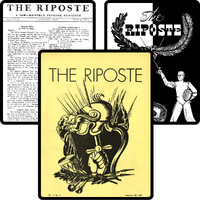
Then came December 19, 1935. I'll never forget that first night when we took the first Riposte to the Fencers Club and paraded it with that pride which only parents can feel. It had no cover, only three bright yellow pages, and the material was very poor mimeograph, held together by a staple at one corner. When we introduced our protege, we were greeted with amused praise and polite compliments.
Although we didn't achieve startling financial success with the first issue, we did succeed in getting the paper talked about (although all the comments were not complimentary) and the kid made his first public speech as follows:
"Fencers have long realized the need for a periodical devoted to fencing news and fencing features. Previous attempts to fill this need have been on a pretentious scale without permanent success. The Riposte is a modest effort. We prefer to expand and improve as your support and encouragement grows. Our enterprise is largely cooperative. Without your support we cannot survive. We would like your financial support, but we need as well your literary contributions . . . reports to the staff of interesting events in your clubs and divisions, juicy gossip notes that should make other fencers chuckle, and the like. We plan to cover the competitions with adequate comments, and eventually include the results of foreign meets. These will be of particular interest with the coming of the Olympics. We have hopes of including, at the proper time, first-hand news stories of the Olympic Games themselves. As the newspaper about fencers, by fencers, and for fencers, The Riposte asks your wholehearted cooperation in a mutually enjoyable enterprise."
After that memorable first issue, we decided to publish every two weeks in the hope that the many people we knew would take a liking to our effort and become interested enough to contribute to its support.
Our second appearance brought enough dimes to cover the cost of the publishing and on our third time out, although we were still living far beyond our means, we discarded the bright yellow outfit and changed to a more conservative buff material. It was still of the cheapest quality, and we were still limited to three pages, but by now the youngster had a full-fledged family. George Breed was our foreign secretary. Barbara Cochrane the circulation manager, Mike de Capriles was technical adviser, which in those days meant that he wrote most of the stuff and acted as our father confessor.
Then came our first big moment. We had refused to accept subscriptions for fear of committing ourselves to a continued appearance. Suddenly Henrique Santos, on his way back to Peru, insisted on a subscription so that he might read what we were doing during his absence. He refused to believe that the magazine might fold.
And so we went along precariously for seven appearances until March of 1936 when our friends Messrs. Castello, Santelli and Vince agreed to help support the growing project by using their advertising. It was about this time that we started a series of articles on judging and directing by our technical adviser. The series was to run for over a year and a half, and was instrumental in furthering the interest of fencers throughout the country. It was our first attempt to contribute something constructive and the response was most gratifying. The series probably did more than any other single thing to enable us to keep going during the trying year.
—
The Riposte’s First Cover
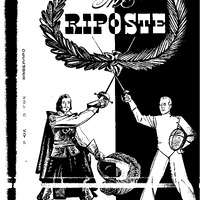
In keeping with our policy, we stayed just one jump ahead of the poorhouse and spent all our money on improving the appearance of our pride and joy. In January of 1937 we presented the growing child with a belated birthday gift—its first cover. It was printed with an attractive design which some people considered a little too martial, but to us it was the most beautiful thing on the market. The inner pages were still cheap mimeograph, but now there were a few more of them. On some appearances we reached as many as fifteen pages.
With the acquisition of the new cover fortune began to smile more broadly. Our advertisers increased, and in November of that year Aldo Nadi began his column “Aldo Nadi says,” a commentary on fencers and fencing. The column was a bombshell. We were flooded with comments pro and con. Some praised Mr. Nadi as a sorely-needed critic to keep fencers and juries on their toes, and predicted that the presence of such an eminent fencer and outspoken critic would be a boon to the sport. Others reprimanded us for permitting anyone to tear our fencers and juries apart so mercilessly; for not censoring the uninhibited Mr. Nadi; for not curtailing his devastating frankness. Whatever view you take of Nadi and his column, there is no denying that everyone looked forward to the next issue—either with annoyed curiosity or pleasant anticipation—to see what he was going to say next. Our circulation increased considerably during these stormy times, and we were able to carry an open-letter page where the supporters and critics of Nadi could fight it out among themselves. Mr. Nadi finally decided to bow to his critics and we carried his last article in June 1938.
For its second anniversary, we changed the design of the cover and increased the contents to an average of twenty pages. Although all the material save the cover was still rather cheap, our little urchin had come a long way. The family, too, had grown. We now had correspondents in the various divisions who sent in periodic reports of activities.
Then, in March of 1938 we took our biggest gamble with the paper’s life. It was now making a monthly appearance, and its contents had increased to about twenty-five pages. We dressed the magazine up in the best possible material—printed, on good coated stock.
We had nursed it through its worst period—the growing pangs and awkward stage had been left behind—but trying days still confronted us. Though it had survived, it had grown so quickly that it was very anaemic and continued to need care. It was in the midst of these trying days that the three-year-old acquired its present editor. Just three years ago Bill Perry found himself too busy to devote much time to the invalid and I was made to realize the truth of the saying that “the law is a jealous mistress.” My studies were to last for another three and a half years and the child needed constant care. Like a true friend and an unselfish devotee of fencing, Dernell Every undertook the task of supervising the magazine’s growth and seeing that it didn’t strain itself too much. He stepped into the breach with his eyes open, and his confidence in our protege’s destiny was justified; his untiring work soon brought the Riposte back to health. Under Dernell’s skillful handling the magazine passed through adolescence into manhood with flying colors. Its development from that time has not been so apparent because there have been no radical changes in its form. But changes there have been, and the improvements have been in the material rather than mere outward appearance. Some people think it takes itself a little too seriously, but that is only natural in a youngster, and the rough edges will be smoothed in time. As it acquires that mellower outlook of middle age it will be able to adjust itself more completely to the fencing environment.
It is impossible to name all the people who have been such a wonderful help in bringing the Riposte to its sixth birthday. They all know how much the family to which they belong appreciates their efforts. However, in order to keep the record straight, we cannot close this review of the past six years without mentioning the constant and tireless assistance of Peggy Every, Helena Mroczkowska, Warren Dow, Donald Barnes, and Burroughs Mitchell.