
Items
In item set
Paintings
-
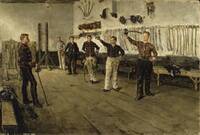 "De Schermles" - The Fencing Lesson Isaac Lazarus Israëls was a Dutch painter associated with the Amsterdam Impressionism movement. This painting depicts an instructor teaching sabre to five students in a fencing school.
-
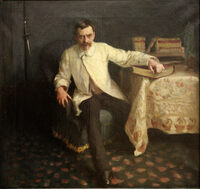 Arsène Vigeant Portrait of Maître d'armes Arsène Vigeant painted by the American painter John Singer Sargent. From "Les insolites du musée de la Cour d’Or de Metz : un portrait pour sceller l’amitié," Le Republican Lorrain, August 20, 2016 [Link]: "Né à Florence en 1856 d’un père américain expatrié en Europe, Sargent a fait les Beaux-Arts à Paris avant de partir en 1886 à Londres pour devenir le portraitiste de la bonne société anglaise. « Il a rencontré Arsène Vigeant entre 1874 et 1886 à Paris par l’entremise de son professeur, le portraitiste Carolus-Duran, qui, lui, était l’élève en escrime de Vigeant », explique Claire Meunier. Né à Metz en 1842, Arsène Vigeant est un maître d’escrime renommé qui fréquente le Tout-Paris aristocratique et bourgeois de l’époque. En 1873, il devient le professeur attitré à Paris du Cercle de l’Union artistique avant de diriger la salle d’armes du Figaro. « En 1885, au moment où Sargent réalise son portrait, Vigeant connaît un tournant dans sa carrière. Suite à un désaccord avec Louis Mérignac, une autre star de l’escrime, il a décidé de quitter le Cercle de l’Union artistique pour devenir historien de l’escrime et collectionneur. C’est ce que Sargent montre dans son œuvre. Il relègue l’épée à l’arrière-plan et met l’accent sur les livres reliés sur la table et rangés sur les étagères. On distingue aussi à droite du tableau une petite statuette en bronze d’une minerve antique du IIe s. » Sargent offrira et dédicacera le tableau à son ami. En 1916, en pleine Guerre mondiale, Vigeant, lui, écrira dans son testament qu’il lègue ce tableau « au musée de Metz, ma ville natale », à condition qu’elle « soit redevenue française ». En 1920, la toile entrera au musée."
-
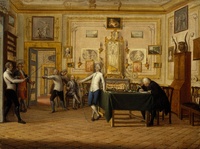 Kenneth Mackenzie, 1st Earl of Seaforth 1744 - 1781 at home in Naples: Fencing Scene Lord Fortrose, later Earl of Seaforth, is the central figure in this painting. He is shown in his rented apartment in Naples, watching his guests practising their fencing moves. The man in black at the table is the Neapolitan composer, Nicolo Jommelli.
-
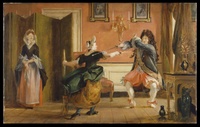 Le Bourgeois Gentilhomme The scene comes from Molière's satirical comedy The Bourgeois Gentleman, which was first performed in 1670. Monsieur Jourdain wishes to be thought of as a gentleman. In demonstrating his new fencing skills to his maidservant Nicole, he is embarrassed to be struck several times by her foil. His wife looks on in amusement.
-
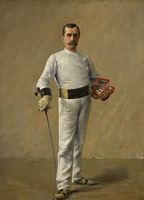 Le Maître d'armes Portrait of Maître d'armes Barthélémy fully dressed for fencing with a foil in his right hand and a mask under left his arm.
-
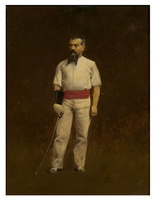 Sir Richard Burton Dressed for Fencing Full length portrait of the explorer Sir Richard Burton dressed for fencing and holding a foil.
-
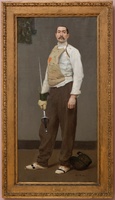 The Fencing Master The Fencing Master is one of two oil paintings of this subject by Melchers. They belong to a small group of full-length pictures of men dressed for their occupational roles. These works are not commissioned portraits but genre paintings in which the individuals are posed in characteristic settings and clothes. Here the emphasis is on the design of the painting rather than the particular identity of the subject, French painter Ernest Noir.