
Items
In item set
Illustration
-
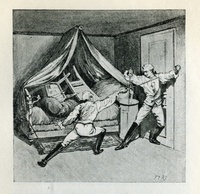 'Chevalier de Malseigne et Marquis de V.' Continued Illustration preceding the almanac entry "Deux Coup d'Épée du Chevalier de Malseigne" in the chapter "Octobre" depicting a 1788 duel in Lunéville (France) between le Chevalier Malseigne and le Marquis de V continued in for former's hotel room for privacy.
-
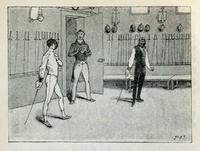 'Duel en Salle d'Armes' Interrupted Illustration preceding the almanac entry "Duel en Salle d'Armes" in the chapter "Mai" depicting a fencing match between Louis Ringal (left) and Octave de Bancas (right) interrupted by Maître d'Armes Vigeant (center).
-
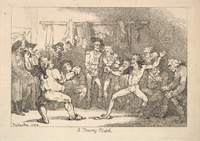 A Fencing Match Etching of a fencing match. Inscribed in plate lower left: "Rowlandson 1788"
-
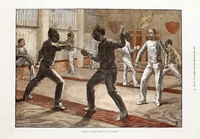 A School of Arms Illustrated newspaper engraving of a fencing school.
-
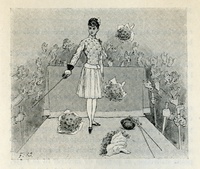 Acclaimed Fencer on Raised Piste Illustration preceding the almanac entry "Une Compensation" in the chapter "Février" depicting a fencer on a raised piste with hands clapping and bouquets being tossed at her.
-
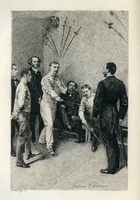 Chapter Illustration for 'l'Esprit des Armes' Illustration preceding the almanac entry "l'Esprit des Armes" in the chapter "Août".
-
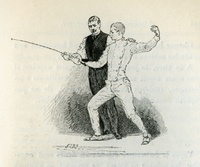 Chapter Illustration for 'l'Esprit des Armes' Illustration preceding the almanac entry "l'Esprit des Armes" in the chapter "Août".
-
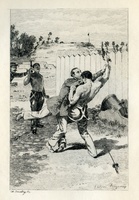 Chapter Illustration for 'Un Duel Corse' Illustration preceding the almanac entry "Un Duel Corse" in the chapter "Novembre", detailing a duel between two Corsican officers in the Bourges garrison fought over their long-standing Gaffori-Santucci family feud. The two combatants fenced with tranquility, reserve, and calm, which was astonishing and suspicious to the presiding master of arms. After a short rest and returning to guard, the combatants signaled to each other and drew revolvers from their trousers. The poised master at arms intercepted Santucci and seized his revolver, and Gaffori dared not shoot for fear of hitting the master. Both were then disarmed and separated by their seconds.
-
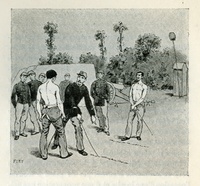 Chapter Illustration for 'Un Duel Corse' Illustration preceding the almanac entry "Un Duel Corse" in the chapter "Novembre", detailing a duel between two Corsican officers in the Bourges garrison fought over their long-standing Gaffori-Santucci family feud. The two combatants fenced with tranquility, reserve, and calm, which was astonishing and suspicious to the presiding master of arms. After a short rest and returning to guard, the combatants signaled to each other and drew revolvers from their trousers. The poised master at arms intercepted Santucci and seized his revolver, and Gaffori dared not shoot for fear of hitting the master. Both were then disarmed and separated by their seconds.
-
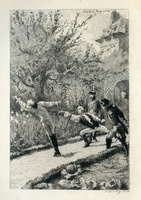 Chevalier de Malseigne et Marquis de V. Illustration preceding the almanac entry "Deux Coup d'Épée du Chevalier de Malseigne" in the chapter "Octobre" depicting a 1788 duel in Lunéville (France) between le Chevalier Malseigne (right) and le Marquis de V (left).
-
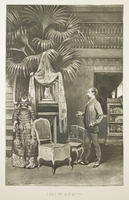 Chez Monsieur Antoine d'Ezpeleta Illustration of Antoine d'Ezpeleta in his home salle d'armes on rue Benouville in Paris, France. Antoine was a celebrated French amateur fencer and president of salle d'armes Merignac.
-
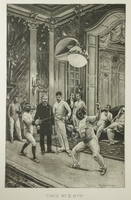 Chez Monsieur Blanc Plate depicting the fencing room, or salle d'armes, of Monsieur Edmond Blanc. The accompanying text, translated from the original French, describes the room: "One of the most artistic fencing rooms is the one that Mr. Edmond Blanc had installed on the first floor of his luxurious hotel on rue Dumont d'Urville. A superb collection of weapons and armor from all countries and from all eras makes you admire the decorations. Helmets of very curious shapes, old breastplates, pistols of great value having belonged to a Russian empress, weapons of all sorts, compose immense side displays. The room is illuminated by a large pink globe emitting electric light."
-
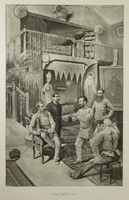 Chez Monsieur Laroze Plate depicting the private home fencing salle of Monsieur Laroze.
-
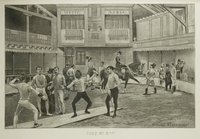 Chez Monsieur Molier Ernest Molier founded Cirque Molier in 1880 which operated until his death in 1933. The circus was popular in Parisien society and featured clowns, mimes, and gymnastics, though was particularly devoted to the horsemanship. Monsieur Molier was also fond of fencing and would sometimes fence on the circus track, where a great sword and horse tournaments were held.
-
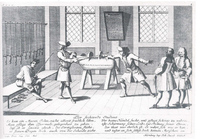 Der Fechtende Student The image shows the university fencing school of Altdorf where the university of the free imperial city of Nürnberg was located. A university fencing instructor holds a lesson. Inscription in German reads as follows: Es kan ein Musen Sohn, nicht allzeit friedlich leben, Man pflegt ihm öfftermals, gelegenheit zu geben, daß ob er sonsten gleich, die Stritigkeiten flieht, er seinen Degen doch, auch von der Scheide zieht. Wer keine Händel sucht, und pflegt sich nur zu wehren, zur Schirmung seines Leibes, zur Rettung seiner Ehren, der thut was ehrlich ist, Er wehrt sich was er kan, und tastet an sich selbst, doch keinen Menschen an."
-
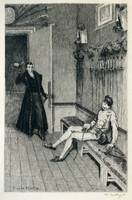 Duel en Salle d'Armes Illustration preceding the almanac entry "Duel en Salle d'Armes" in the chapter "Mai" depicting Louis Ringal, seated and in uniform awaiting his lesson with Maitre Vigeant, with Octave de Bancas entering the salle.
-
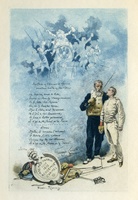 Frontispiece to l'Almanac d'Escrime Frontispiece to "L'Almanach de l'Escrime" by fencing master Arsène Vigeant. Depicts a fencing master and student both in full fencing attire. Includes an excerpt of the poem "Ballade en l'Honnor de Vigeant" written in July 1888 by François Coppée, which was typed in full on the proceeding pages of the text. The excerpt reads:"La rapière, arme de butor,Traîne au flanc des "Miasons Moussues"Et le futur herr ProfessorEst fier des balafres reçues.Mais le sabre lourd vainementA l'épée a fait concurrence;Et, pour se battre galamment,Il n'est de fin fleuret qu'en France......................Envoi.Maître, il reviendra, l'Allemand.O victoire! O chère espérance!...Enseigne-nous ton art charmant.Il n'est de fin fleuret qu'en France.
-
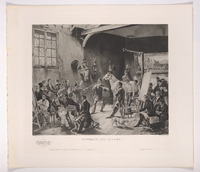 Intérieur d'un Atelier (The Studio of Horace Vernet) Aquatint of an original painting by Horace Vernet depicting his studio with individuals fencing, boxing, painting, and playing music.
-
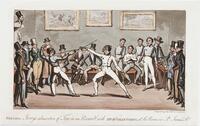 Jerry's admiration of Tom in an "assault" with Mr. O'Shaunessy at the rooms in St. James's Stt. Tom fences with the fencing-master as spectators stand round the room or sit on a bench along the back wall, some wearing fencing jackets, others top-hatted. On the right is a table with foils laid out. On the back wall are three pictures: a battle-piece and two landscapes.
-
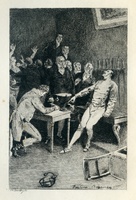 La Résurrection de Pons Illustration preceding the almanac entry "La Résurrection de Pons" in the chapter "Janvier" depicting the accident during the fencing match between Alphonse Pons, eldest son of Maître d'Armes Pons, and Lord Geffrin wherein the latter's foil broke 20 centimeters from the point to strike Alphonse Pons in the chest. Though he survived the accident, Alphonse Pons immediately called for the dictation of a letter to his daughter proclaiming his impending death saying "Ma fille, je vais mourir. C'est ma faute. J'aurais dù parer deux fois. Ma dernière pensée est pour toi, je te confie à Dieu et à mes amis."
-
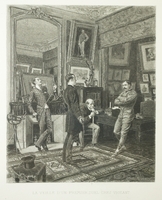 La Veille d'un Premier Duel Chez Vigeant Frontispiece to "A Travers les Salles d'Armes" depicting the home of fencing master Arsène Vigeant. Vigeant was an avid collector of fencing art and published a catalog of his collection in 1892 titled "Ma Collection d'Escrime".
-
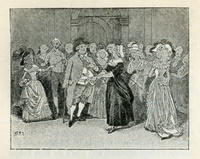 Le Chevalier d'Eon Illustration preceding the almanac entry "La Résurrection de Pons" in the chapter "Janvier" depicting Chevalier d'Eon with a fencing foil.
-
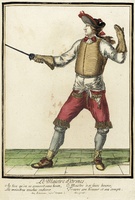 Le Maistre d'Armes Fencing master, in profile to the left, with sword in right hand.
-
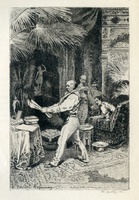 Maître André Stephanoff before a Lesson Illustration preceding the almanac entry "Une Compensation" in the chapter "Février" depicting Maître André Stephanoff, fencing master to the court in St. Petersburg, reading the newspaper in Count Batchoff's smoking room before a fencing lesson.
-
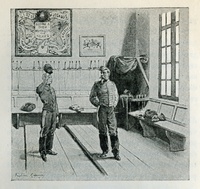 Military Salle d'Armes in Metz Illustration preceding the almanac entry "Une Duel Militaire" in the chapter "Avril" depicting Maître d'Armes Payen in the military fencing school of the Hussards in the Metz garrison.