-
 Certificate of Merit
-
 Challenges Tronchet to Sword Fight
-
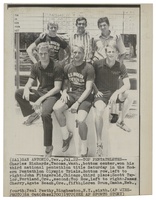 Champions of the 1972 Modern Pentathlon Olympic Trials
Top six competitors of the 1972 Modern Pentathlon Olympic Trials. Top row, from left to right: James Cherry (5th place), Loren Drum (4th place), Paul Pesthy (6th place). Bottom row, left to right: John Fitzgerald (3rd place), Charles Richards (1st place), Scott Taylor (2nd place).
Richards, Taylor, and Fitzgerald (bottom row, top three competitors) participated in the modern pentathlon event at the 1972 Olympic Games.
Caption on obverse:
"San antonio, TEX, JUL. 22--TOP PENTATHLETES--
Charles Richards, Tacoma Wash., bottom center, won his third national pentathlon title Saturday in the Modern Pentathlon Olympic Trials. Bottom Row, left to right: John Fitzgerald, Chicago, third place; Scott Taylor, Portland, Ore., second; Top row, left to right: James Cherry, Agate Beach, Ore., fifth; Loren Drum, Omaha, Neb., fourth; Paul Pesthy, Binghamton, N.Y., sixth."
-
 Championships Still "On Schedule"
-
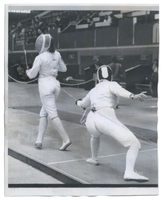 Chantal Depetris fencing Yelena Belova in Foil
Marie-Chantal Depetris of France fencing Yelena Dmitriyevna Novikova-Belova of the Soviet Union in foil at the 1968 Olympic Games.
Caption on reverse:
"Chantal Depretis of France scoring point against Elena Novikova of Soviet Union in foil"
-
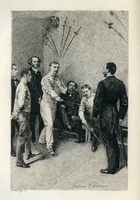 Chapter Illustration for 'l'Esprit des Armes'
Illustration preceding the almanac entry "l'Esprit des Armes" in the chapter "Août".
-
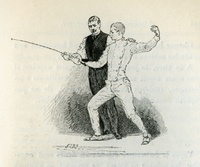 Chapter Illustration for 'l'Esprit des Armes'
Illustration preceding the almanac entry "l'Esprit des Armes" in the chapter "Août".
-
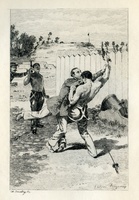 Chapter Illustration for 'Un Duel Corse'
Illustration preceding the almanac entry "Un Duel Corse" in the chapter "Novembre", detailing a duel between two Corsican officers in the Bourges garrison fought over their long-standing Gaffori-Santucci family feud. The two combatants fenced with tranquility, reserve, and calm, which was astonishing and suspicious to the presiding master of arms. After a short rest and returning to guard, the combatants signaled to each other and drew revolvers from their trousers. The poised master at arms intercepted Santucci and seized his revolver, and Gaffori dared not shoot for fear of hitting the master. Both were then disarmed and separated by their seconds.
-
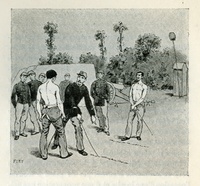 Chapter Illustration for 'Un Duel Corse'
Illustration preceding the almanac entry "Un Duel Corse" in the chapter "Novembre", detailing a duel between two Corsican officers in the Bourges garrison fought over their long-standing Gaffori-Santucci family feud. The two combatants fenced with tranquility, reserve, and calm, which was astonishing and suspicious to the presiding master of arms. After a short rest and returning to guard, the combatants signaled to each other and drew revolvers from their trousers. The poised master at arms intercepted Santucci and seized his revolver, and Gaffori dared not shoot for fear of hitting the master. Both were then disarmed and separated by their seconds.
-
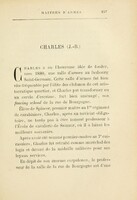 Charles (J.-B.)
This chapter from "Amateurs et salles d'armes de Paris" by Adolphe Tavernier highlights Charles (J.-B.), who established a successful fencing school in the Faubourg Saint-Germain around 1880, quickly attracting the elite of the aristocratic neighborhood. A student of Spincer, Charles served as a professor at the École de cavalerie de Saumur and later as the first master at the 7th Cuirassiers before retiring with honors. Despite his large physique, Charles is noted for his agility and strategic prowess, preferring to counter his opponents with well-timed ripostes. As a professor, he is beloved by his students for his clear teaching style. The fencing circle he founded is led by President G. de Bonnegarde and Vice-President Vicomte Robert de Rougé, and includes many skilled fencers such as the Marquis de la Mazelière, the Baron de Coubertin, and the Duke of Rochefoucauld. The circle boasts a distinguished membership, including honorary members like Captain Dérué and E. Dollfus, making Charles’s salle d'armes a prominent institution in Parisian fencing.
-
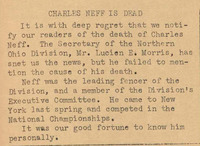 Charles Neff is Dead
-
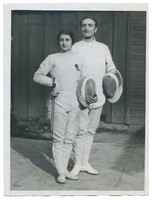 Charles Vical with Daughter Jeanne Vical
Professor and Captain Charles Vical with daughter, fencer Jeanne Vical
Caption on reverse:
"Prof. Charles Vical and Daughter Jeanne
Santa Monica, Calif. ---- Prof. Charles Vical; LL.M.Lic.En.Dr. one of the most famous of French swordsman who has been a resident of Santa Monica, Calif. prepares to leave for Paris where he will assist in organizing the French fencing team which will compete in the 1932 Olympic Games at Los Angeles. He will accompany the team back to Los Angeles as an instructor. Leaving for France with him is his daughter, Mme. Jeanne Vical, internationally famous girl fencer, Prof. Vical served as captain in the French army during the war and has been decorated with the Croix de Guerre as well as being made a Chevalier de la Legion D'Honneur and Chevalier de la Couronne D'Italie. Photo shows Professor Vical and daughter Jeanne. 9/15/31"
-
 Chazalet
This chapter from "Amateurs et salles d'armes de Paris" by Adolphe Tavernier describes Chazalet, a skilled fencing master who succeeded "Père Boyer" and is known for his serious approach to teaching and public bouts. At thirty-six years old, Chazalet is a well-built, good-humored individual whose demeanor contrasts with some of his more dour colleagues. He began his fencing career in the military and quickly rose through the ranks, demonstrating both natural talent and dedication. After his military service, he worked under several prominent fencing masters before taking over Boyer’s salle d'armes, where he has continued the tradition of training excellent fencers. Chazalet's style is characterized by his offensive approach, with a preference for one-two and one-two-three attacks, and his ability to execute precise parries and ripostes. Known for his classical and elegant technique, Chazalet is a sought-after partner in public fencing matches.
-
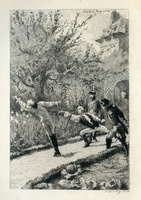 Chevalier de Malseigne et Marquis de V.
Illustration preceding the almanac entry "Deux Coup d'Épée du Chevalier de Malseigne" in the chapter "Octobre" depicting a 1788 duel in Lunéville (France) between le Chevalier Malseigne (right) and le Marquis de V (left).
-
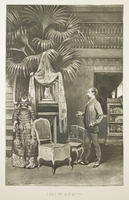 Chez Monsieur Antoine d'Ezpeleta
Illustration of Antoine d'Ezpeleta in his home salle d'armes on rue Benouville in Paris, France. Antoine was a celebrated French amateur fencer and president of salle d'armes Merignac.
-
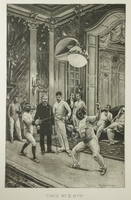 Chez Monsieur Blanc
Plate depicting the fencing room, or salle d'armes, of Monsieur Edmond Blanc. The accompanying text, translated from the original French, describes the room: "One of the most artistic fencing rooms is the one that Mr. Edmond Blanc had installed on the first floor of his luxurious hotel on rue Dumont d'Urville. A superb collection of weapons and armor from all countries and from all eras makes you admire the decorations. Helmets of very curious shapes, old breastplates, pistols of great value having belonged to a Russian empress, weapons of all sorts, compose immense side displays. The room is illuminated by a large pink globe emitting electric light."
-
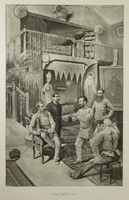 Chez Monsieur Laroze
Plate depicting the private home fencing salle of Monsieur Laroze.
-
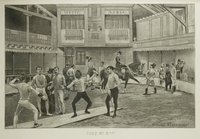 Chez Monsieur Molier
Ernest Molier founded Cirque Molier in 1880 which operated until his death in 1933. The circus was popular in Parisien society and featured clowns, mimes, and gymnastics, though was particularly devoted to the horsemanship. Monsieur Molier was also fond of fencing and would sometimes fence on the circus track, where a great sword and horse tournaments were held.
-
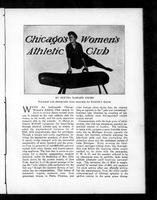 Chicago's Women's Athletic Club
The article highlights the Chicago Women’s Athletic Club, which was the first athletic and social club exclusively for women, and the most expensive of its kind in the U.S. at the time of its opening. Offering luxurious amenities in a $100,000 facility, it charged an unprecedented $100 initiation fee, attracting an elite membership of 700 women. Despite initial skepticism, the club flourished and inspired similar ventures, such as one led by Mrs. John Jacob Astor in New York.
Located on Michigan Avenue, the club featured lavish facilities, including a marble swimming pool, gymnasium, and various beauty services, catering to high-society women such as Mrs. Philip D. Armour and Mrs. Cyrus McCormick. Members participated in activities ranging from aesthetic calisthenics to swimming and fencing, while also enjoying luxurious relaxation spaces. Although men were not officially involved, they were often present at social events hosted by the club.
The article credits the club’s success to Mrs. Paulina Harriette Lyon, who overcame initial doubts to bring her vision to life. Plans for a new $600,000 facility, complete with expanded athletic and social amenities, were in progress, promising to further enhance the club's prestige.
-
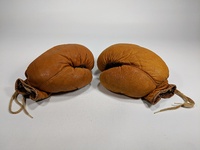 Child's Boxing Gloves
Pair of child's boxing gloves with thick horsehair padding on the back of the hand and soft leather palm. Imprinted silver manufacturer's mark on both gloves's cuff reads "JC Higgins" (cursive) inside a circle with "Sears, Roebuck and Co." (print) along the inside edge of the bottom hemisphere's. "1415" written in large size below the mark.
-
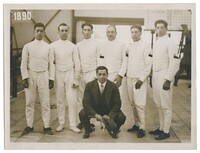 Chilean Fencing Team at 1928 Olympics
A photograph of the Chilean Fencing Team at the 1928 Olympics. Suspected identities include Jorge Garretón Prieto (second from left), Óscar Novoa Fuentes (forth from left) Tomás León Goyoaga Palacios (fifth from right), Nemoroso Riqualme Loyola (kneeling).
Stamps on the back address payment for media reproduction and use of the photograph in different countries.
-
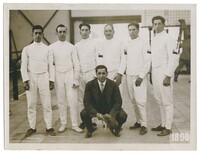 Chilean Fencing Team at 1928 Olympics
A second printing of the photograph of the Chilean Fencing Team at the 1928 Olympics. Suspected identities include Jorge Garretón Prieto (second from left), Óscar Novoa Fuentes (forth from left) Tomás León Goyoaga Palacios (fifth from right), Nemoroso Riqualme Loyola (kneeling).
Stamps on the back address payment for media reproduction and use of the photograph in different countries.
-
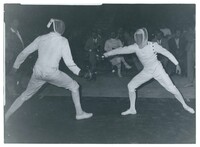 Claude Arabo versus Wilfried Wöhler in Individual Saber Match
Claude Arabo (right) of France fences Wilfried Wöhler (left) of Germany during the Men's Individual Saber match.
-
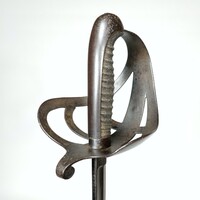 Clemen & Jung Fencing Sabre
Fencing sabre with shagreen grip and pierced plate guard. Blade is fullered on both sides from the forte until the foible and the point is rounded. Peened hilt. Possible Clemen & Jung makers mark on the forte, resembling a shield with a five-pointed crown. Grip wrapped with cord and shagreen with remnants of twisted brass wire.
-
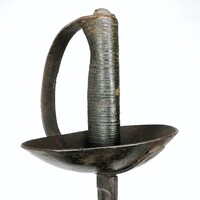 Clemen & Jung Fencing Sabre
Heavy fencing sabre with curved blade marked with a Clemen & Jung makers mark on the ricasso, depicting a shield with the letter 'z" in the center and with a five-pointed crown above. Sabre's guard is a simple dish with a riveted-on knucklebow. Thick grip is wrapped in sealed or painted cord.
