 The Doom of the Sword
The article discusses the decline of the sword in modern warfare, symbolizing the broader shift from ornamental military traditions to practical combat realities. A comparison is made between a ceremonial Life Guardsman and a soldier in functional khaki, illustrating the need for inconspicuousness on the battlefield. The article criticizes the military's initial failure to adapt, resulting in high officer casualties due to their distinctive uniforms. Over time, officers adopted rifles and blended in with soldiers, making the sword obsolete. The sword, once a symbol of honor and tradition, has lost its relevance in modern combat, replaced by more practical weapons like the bayonet, revolver, and lance. Despite its romantic significance, the article argues that the sword's usefulness has ended. The focus should now be on efficiency and survival rather than maintaining outdated symbols. However, the article affirms that the courage and professionalism of soldiers remain undiminished.
 The Development of Fencing
The article explores the paradox that the development of fencing as an art was driven by the introduction of gunpowder, which simultaneously led to the decline of swordsmanship in practical combat. Fencing, revived during the Renaissance after being nearly lost in the Middle Ages, reached its height in the 18th century before evolving into more of a sport than a battlefield skill. Early fencing focused on offensive skills, as survival in combat depended on quickly incapacitating one’s opponent rather than defending against attacks. However, the perfection of firearms eventually relegated fencing to a secondary role in warfare.
The article also traces the rise of fencing schools across Europe, such as the Brotherhood of St. Mark in Germany and similar guilds in Italy and Spain. These schools formalized the teaching of swordsmanship and monopolized its practice, with rigorous training and examinations for students aspiring to become masters. Italy became a central hub for fencing, influencing the development of fencing techniques across Europe, although Spain also had a lasting impact.
By the 16th century, the use of the sword for both offense and defense was formalized, and printed fencing manuals helped disseminate knowledge across borders. Italian masters were particularly influential, but the French school eventually rose to prominence in the 17th century, refining techniques such as parrying, riposting, and the use of lighter weapons. The evolution of fencing continued into the 18th century, with further innovations in style and technique, as fencing became more of an art form and sport rather than a practical means of combat.

 The Greco Academy Moves to New Salle
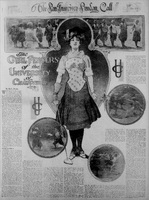 The Girl Fencers of the University Of California
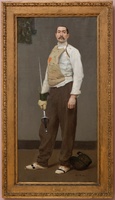 The Fencing Master The Fencing Master is one of two oil paintings of this subject by Melchers. They belong to a small group of full-length pictures of men dressed for their occupational roles. These works are not commissioned portraits but genre paintings in which the individuals are posed in characteristic settings and clothes. Here the emphasis is on the design of the painting rather than the particular identity of the subject, French painter Ernest Noir.
 The Fencing Girl
 The Fencing Exhibition Last Night
 The Feminine Touch
 The Feminine Touch
 The Feminine Touch
 The Feminine Touch
 The Feminine Touch
 The Feminine Touch
 The Epee Championships
 The Epee : The Practice Session
 The Epee : Combat Tactics
 The Epee
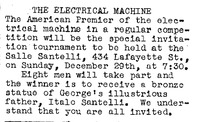 The Electrical Machine
 The Electrical Foil!!!
 The Editor Goes Roaming
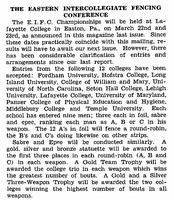 The Eastern Intercollegiate Fencing Conference
 The East-West Intercollegiate Championships
 The Dueling Pistols of the Late General Meagher
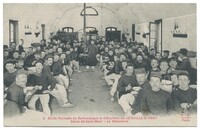 The Dining Hall at Joinville Postcard with photograph from the Ecole Normale Militaire de Gymnastique et d'Escrime at Joinville-le-Pont. A group of soldiers in uniform share a meal at the dining hall.
 The Cleveland Plaque Tournament