-
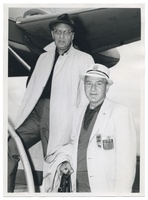 de Capriles and Worth en route to Mexico
Miguel de Capriles (left) and George Worth (right) pose for the camera aside an airplane having likely just arrived in Mexico. The two men, both fluent in Spanish, traveled to Mexico City for the 1968 Olympics either as referees or team officials.
-
 De Capriles Brothers Sweep Metropolitan Championship
-
 De la Susceptibilité Chez les Escrimeurs
The article discusses the sensitivity and pride among fencers, likening them to musicians in their quickness to take offense. It recounts a dispute over the Albert Marone Cup, where the organisers (La Rapière) responded sharply to criticism after Italian teams won due to cost-cutting measures excluding the French team. The author emphasizes the significance of French international fencing victories in upholding France's fencing reputation and the necessity for unity among fencers to combat dwindling public interest in the sport, calling for a cohesive approach to preserve its standing.
-
 De Smytters
This chapter from "Amateurs et salles d'armes de Paris" by Adolphe Tavernier highlights De Smytters, a veteran fencing master who, despite being 72 years old, remains energetic and active. De Smytters' career began with a notable military achievement, where his vigilance and skill as a sentry likely saved a French division during a critical moment before a battle near Antwerp. Trained by the esteemed master Arnault, De Smytters went on to practice with and learn from renowned fencers of his time, such as Bonnet, Lafaugère, Cordelois, and Daressy. He taught at Leboucher's salle in Paris before establishing his own salle on rue Monsigny and later rue Godot-de-Mauroy, where he attracted a dedicated group of students. Although he now only teaches in a few select locations, including Ruzé's salle, De Smytters is still highly regarded, particularly for his work with his devoted student, M. Poupeins-Maufrais.
-
 Démocratisons l'Escrime
The author, Joe Bridge, laments the decline of fencing as a national sport in France, attributing its waning popularity to the rise of cycling, football, and boxing. Despite the setbacks, including the impact of war, he believes fencing remains the most quintessentially French sport, characterized by improvisation and intellectual engagement. Bridge argues that fencing's intellectual demands can be both a strength and a weakness, suggesting it could provide mental relief for manual laborers while being overly taxing for intellectuals. He calls for the democratization of fencing through evening classes to rejuvenate the sport and prepare young people for military service exams. Bridge emphasizes that fencing is not prohibitively expensive compared to other sports and could achieve popularity similar to rugby if embraced by a broader audience. He concludes that fencing will thrive if it becomes more inclusive, but it risks dying out if it remains elitist.
-
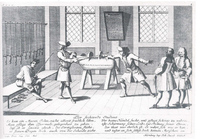 Der Fechtende Student
The image shows the university fencing school of Altdorf where the university of the free imperial city of Nürnberg was located. A university fencing instructor holds a lesson. Inscription in German reads as follows:
Es kan ein Musen Sohn, nicht allzeit friedlich leben,
Man pflegt ihm öfftermals, gelegenheit zu geben,
daß ob er sonsten gleich, die Stritigkeiten flieht,
er seinen Degen doch, auch von der Scheide zieht.
Wer keine Händel sucht, und pflegt sich nur zu wehren,
zur Schirmung seines Leibes, zur Rettung seiner Ehren,
der thut was ehrlich ist, Er wehrt sich was er kan,
und tastet an sich selbst, doch keinen Menschen an."
-
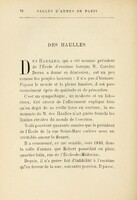 Des Haulles
This chapter from "Amateurs et salles d'armes de Paris" by Adolphe Tavernier profiles Des Haulles, a modest and skilled fencer who has quietly made a significant impact within the fencing community. Recently appointed president of the École d'escrime after Carolus Duran's resignation, Des Haulles has dedicated over forty years to the art of fencing, beginning his training around 1840 at Robert's salle d'armes in the Latin Quarter. Despite his proficiency, Des Haulles prefers a life of quietude, keeping his renown largely within the confines of the fencing world. Known for his powerful build and surprising agility, he combines a methodical and strategic approach with bursts of unexpected aggression. His deep knowledge of fencing and his ability to outmaneuver opponents make him a formidable adversary. Des Haulles is respected not only for his fencing skills but also for his integrity and straightforward character, earning him widespread admiration among his peers.
-
 Désiré Robert
This chapter from "Amateurs et salles d'armes de Paris" by Adolphe Tavernier reflects on the life and legacy of Désiré Robert, who passed away three years ago at a young age, succumbing to rheumatic fever complicated by heart disease. Désiré was the son of J.-B. Robert, a renowned fencing master, and the brother of Robert aîné, another prominent figure in the fencing world. Known for his correct form, Désiré excelled in classical fencing, compensating for his physical limitations with exceptional precision and judgment. He was highly regarded for his integrity and sportsmanship, making him a sought-after partner in fencing circles. Désiré taught at the cercle d'escrime on rue du Helder, founded by his nephew Georges, and was beloved for his patient and conscientious instruction. His passing was a significant loss to the fencing community, where he was respected and admired for his expertise and character.
-
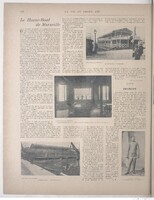 Desmedt
The article mourns the loss of Eugène Desmedt, a notable figure in Belgian fencing, who died at the age of 44. Known for his public fencing duels both in Belgium and abroad, Desmedt was celebrated for his exceptional physical abilities and his analytical prowess in deciphering complex fencing styles from various schools. He authored "La Science de l’Escrime" in 1888, documenting his extensive research and experiences in the sport. After publishing his book, Desmedt shifted his focus from competing to teaching, continuously refining his instructional methods. His teaching was heavily influenced by his time at the French school of Joinville, which shaped his approach to fencing education.
-
 Detroit
-
 Detroit Topics
-
 Deux Balles Échangées Sans Résultat
The article discusses techniques for rendering pistol duels less dangerous through manipulation during the weapon-loading process. It questions whether the low risk in French duels is due to chance or deliberate tampering by witnesses, referencing Emile André's work on duel tricks involving fake bullets and powder manipulation. The article critiques some of these methods as either childish or hazardous, emphasizing the importance of skilled hands in properly loading a pistol. It outlines three specific tricks that reduce the lethality of a pistol shot, such as reducing the amount of gunpowder or improperly seating the bullet. The piece calls on duel witnesses to stay vigilant against such tricks to ensure fairness, while also providing detailed steps for correct loading.
-
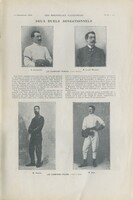 Deux Duels Sensationnels
Article on the imminent double duel of two well-known Italian masters, Pessina and Vega, against two well-known French masters, Kirchhoffer and Lucien Mérignac.
The encounter between these masters was initially designed to be serious but courteous assaults with point d'arret-equipped foils, but degenerated into duels after Pessina and Vega published letters in Neapolitan newspapers that Kirchhoffer and Mérignac took offense to.
-
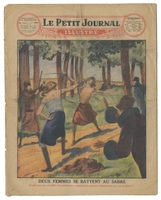 Deux Femmes se Battent au Sabre
Cover illustration and narrative account of a sabre duel between two Polish women near Lemberg (the German name for Lviv, Ukraine). The two women, just twenty years old, had fallen in love with the same man and thought only a duel could decide between then. The duel took place in a wood in the presence of witnesses and ended when one duelist received a disfiguring cut to the face. Article accompanying the cover illustration found on page 242 of the periodical.
-
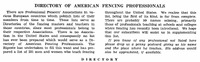 Directory of American Fencing Professionals
-
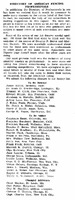 Directory of American Fencing Professionals
-
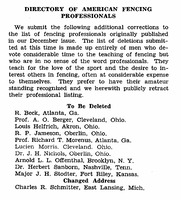 Directory of American Fencing Professionals
-
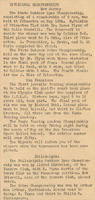 Divisional Championships
-
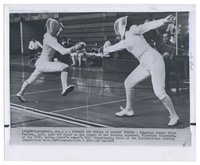 Domolky and Kiselyova Fencing Foil
Linda Domolky (Hungary, depicted at left) fencing Valentina Kiselyova (Soviet Union, depicted at right) at the 1958 World Fencing Championships held in Philadelphia, United States. Kiselyova won gold in the women's individual foil event at this competition.
Caption on obverse:
"PHILADELPHIA, AUG. 20 - HUNGARY AND RUSSIA AT SWORDS' POINTS -
Hungarian fencer Linda Domolky, left, goes off floor as she lunges at her Russian opponent, Valentina Kisseleva, of the USSR, during today's women's foil championship bouts at the international fencing competition here."
-
 Don't Forget Your Seals
-
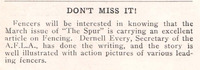 Don't Miss it!
-
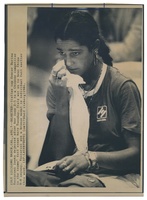 Dorina Vaccaroni Sheds a Tear After Losing Bout
Dorina Vaccaroni (Italy) sheds a tear after losing a bout to a fencer from the Chinese team in the in the women's team foil event at the 1984 Olympic Games. Italy placed forth in this event.
Caption on obverse:
"LONG BEACH, CAL., AUG. 7--DEJECTED--Italian top fencer Dorina Vaccaroni looks dejected after her loss 2-5 to a Chinese competitor in the team's foil event here Tuesday. Italy wnr on to beat China 9-8 anyway. Vaccaroni won a bronze medal in individual foil earlier this week."
-
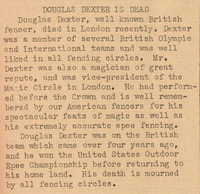 Douglas Dexter is Dead
-
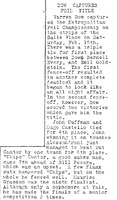 Dow Captures Foil Title
-
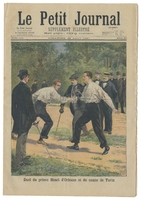 Duel du prince Henri d'Orléans et du Comte de Turin
Cover engraving depicting the duel between Prince Henri of Orléans and Prince Vittorio Emanuele, the Count of Turin. Vittorio challenged Henri to a duel following Henri's published description of Italian prisoners in Ethiopia as cowards. The duel occurred on August 15th, 1897 lasting 26 minutes and ending after Henri received a serious wound to the abdomen.
A short description of the duel is found on page 279, along with a short editorial (roughly translated from the original French):
"If we [the story of the duel] had stopped there, it would have been perfect. Why were the Italian newspapers so lacking in tact as to spoil with ridiculous ranting the memory of this chivalrous meeting of two brave, generous young people, both worthy of the warm sympathy of men of heart?"
