-
 Editorial
-
 Editorial
-
 Editorial
-
 Editorial
-
 Editorial
-
 Editorial
-
 Editorial
-
 Editorial
-
 Editorial
-
 Editorial Note
-
 Editorially Speaking
-
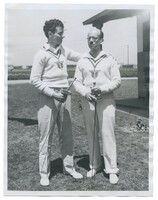 Edwardo Prieto Lopez and Edwardo Prieto Souza at the 1932 Olympics
Portrait of Edwardo Prieto Souza and his son Edwardo Prieto Lopez, both members of the Mexican fencing team, at the 1932 Olympics.
Caption on reverse:
For the first time in the history of the Olympic Games
A father and son are competing on the same teams. Edwardo Prieto Souza, 50 years of age and his son Edwardo Prieto Lopez age 20 are both members of the Mexican sword team. They are the oldest and youngest of the squad of 48 Mexican athletes now quartered in the Olympic Village. The elder Souza explained that his son had a different last name for the reason that in Mexico the children take the name of their father and then add their mother's name.
Photo shows Edwardo Prieto Lopez and his father Edwardo Prieto Souza at the Olympic Village, Los Angeles.
-
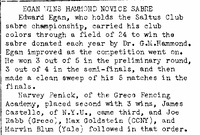 Egan Wins Hamond Novice Sabre
-
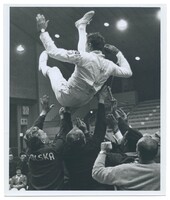 Egon Franke wins Gold
The Polish team celebrates Egon Franke's win for Individual Foil at the 1964 Olympics
-
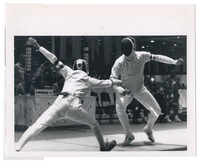 El-Husseini and Borella Fencing Foil
Abdel Monem Ahmad El-Husseini (Egypt, depicted at left) fencing Andrea Borella (Italy, depicted at right) in the men's individual foil event at the 1984 Olympic Games.
-
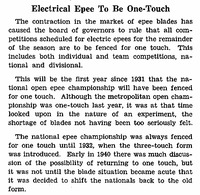 Electrical Epee to Be One-Touch
-
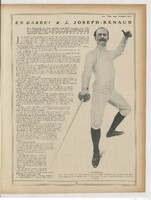 En Garde! — J. Joseph-Renaud
The article, written by Robert Dieudonné, celebrates the life and achievements of J. Joseph-Renaud, a distinguished French fencer and versatile sportsman. Joseph-Renaud is portrayed as a master of multiple disciplines, not only excelling in fencing but also in boxing, pistol shooting, jiu-jitsu, and other forms of self-defense. His reputation in fencing is unrivaled, and his approach to the sport is described as both scientific and artistic, blending physical prowess with intellectual strategy. The article highlights his unique ability to combine sportsmanship with literary finesse, often likening his fencing to writing, where each move reflects careful thought and precision. Despite his many successes, Joseph-Renaud is depicted as humble and peaceful in everyday life, a man driven by passion rather than vanity. His legacy is framed as that of both an athlete and a writer, blending the worlds of sport and literature seamlessly.
-
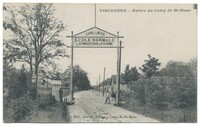 Entrance to Camp de Saint Maur
Photo postcard depicting the entrance to the École Normale Militaire de Gymnastique et de Escrime at the the Camp de Saint Maur.
-
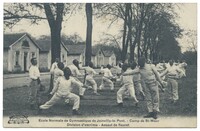 Epee Assaults at Joinville
Postcard with photograph from the Ecole Normale Militaire de Gymnastique et d'Escrime at Joinville-le-Pont. Taken at Camp de St-Maur. Even though the postcard is labeled as “Assaut de Fleuret,” the group of fencers in this photograph are fencing with epees. The fencer on the right can be seen performing a stop-thrust to the wrist of the fencer on the left.
-
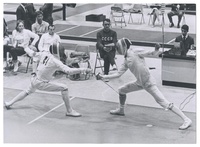 Epee Bout at the 1968 Olympics
Two fencers (indicated only as fencer "41" and fencer "38") fence epee at the 1968 Summer Olympics.
-
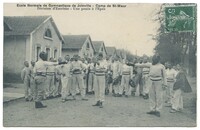 Epee Competition at Joinville
Postcard with photograph from the Ecole Normale Militaire de Gymnastique et d'Escrime at Joinville-le-Pont. Taken at Camp de St-Maur labeled as “Une Poule a I’Epee." A crowd watches two epee fencers as a director holds their points together prior to an assault.
-
 Epee Individuals
-
 Epee Team Results
-
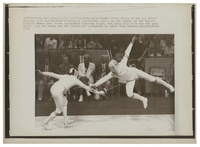 Erdős and Suchanecki Fencing Epee in the Finals
Sándor Erdős (Hungary, depicted right) fencing with François Suchanecki (Switzerland, depicted left) in the finals of the men's team epee competition during the 1972 Olympic Games. The Hungarian team won the gold medal, and the Swiss won the Silver.
Caption on obverse:
"Munich, Sept. 10--Flying Fencing--Hungary's Sandor Edoes leaps in the air while fencing with Switzerland's Francois Suchanecki, left, in the finals of the Munich Olymic Games epee teams tournament Saturday night. The Hungarian team won the gold medal, and the Swiss won the Silver."
-
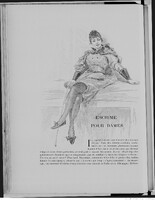 Escrime pour Dames
The text offers an exploration of women throughout history who have engaged in sword fighting and dueling, focusing not only on military figures but also those who took up arms for personal or recreational reasons. It references historical examples like Roman patrician women who fought in circuses, noblewomen in medieval Italy and Germany, and dueling princesses in 18th-century France. Anecdotes of famous female duelists such as Mademoiselle de Maupin, who led a life of flamboyant swordsmanship, and the scandalous duels involving aristocratic women in Paris are highlighted. The text also introduces Madame Astié de Valsayre, a 19th-century advocate for women's fencing, who famously dueled with an American woman and campaigned for fencing as a form of physical and moral regeneration for women. Despite fencing's decline in popularity among women by the end of the 19th century, the text suggests that it remains an elegant and beneficial sport, with historical and contemporary examples of women engaging in it. Finally, it encourages a revival of female participation in fencing as a sport that enhances both physical grace and beauty.
