-
 Et le Duel?
The article argues that attempts to prevent duels are futile, as long as there are people driven by vengeance, anger, or jealousy who will engage in them. It dismisses criticisms of dueling as immoral, suggesting it is no different from other forms of physical conflict like boxing or cane fighting. The author contends that dueling serves a necessary function as an elegant solution to resolving otherwise irreparable personal conflicts, where formal proceedings might fail. However, it acknowledges the role of witnesses and the Fédération nationale d'Escrime in attempting reconciliation and ensuring duels are conducted with seriousness and gravity, before ultimately accepting that in matters of honor where lives are at stake, divine judgment alone decides.
-
 États-Unis : New-York
The article details several fencing events and developments in New York, focusing on intercollegiate and community competitions. The Intercollegiate Championships of Épée and Foil were held on March 30-31, with the Naval Academy of Annapolis securing the team title in the foil event. Shears from the Naval Academy achieved an unexpected victory in the individual foil event, surpassing his captain, while Calloway also took first in the individual épée category. Additionally, the French Fencing Academy of New York is highlighted for its activities under maître Cabijos, who organized an épée tournament for French War Veterans and a women's foil championship, won by Miss Florence Boeton. Marymount College of Tarrytown-on-Hudson and Sainte-Agathe School are commended for promoting fencing, with each institution naming the members of their respective teams. Both schools emphasize the physical and moral benefits of fencing, with future events planned under the guidance of maître Cabijos. Overall, the article underscores the growing influence of French fencing and the active involvement of women and institutions in the sport.
-
 États-Unis : New-York
The article highlights the efforts of Professor Marcel Cabijos in promoting French fencing in New York City. Already responsible for teaching at several prestigious institutions, including Vassar College, Marymount College, Saint Agatha School for Girls, and the New York Collegiate School for Boys, Cabijos is expanding his reach. He is now introducing fencing to students at the Ethical Culture School and Larchmont Presbyterian Church, each with two sections of pupils. To encourage competition and skill development, Cabijos organizes several contests with attractive prizes. The article commends his dedication, suggesting that his initiatives will further popularize fencing among the city’s youth.
-
 Ethics of the Fencing Strip
-
 Ethics on the Fencing Strip
-
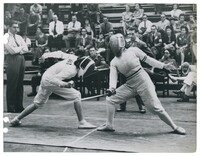 Éva Kun and Irene Camber-Corno Compete at Wembley
Éva Kun of Hungary (left) and Irene Camber-Corno of Italy (right) compete at Wembley in the Women's Foils of the 1948 Olympic games.
Caption:
Photo Shows: I.E. Kum [sic] of Hungary (left) and I. Camber of Italy competing in the semi-finals of the Foil (Individual) Ladies, at the Palace of Engineering, Wembley.
-
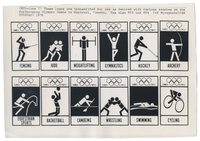 Event Logos for the 1976 Olympic Games
Event logos for the 1976 Olympic Games. Top row, from left to right: fencing, judo, weightlifting, gymnastics, hockey, archery. Bottom row, from left to right: equestrian sports, basketball, canoeing, wrestling, swimming, cycling.
Caption on obverse:
"(NY5-June 7) These logos are transmitted for use as desired with various stories on the forthcoming Olympic Games in Montreal, Canada. See also NY3 and NY4."
-
 Exemptions for Nationals Increased
-
 Exercise for Women : IV. The Use of the Arms—Fencing
The article examines the evolution of exercise for women, specifically emphasizing the importance of arm movement and fencing as a beneficial activity. It critiques traditional ideals that promoted stillness and restraint in women, contrasting them with the growing acceptance of physical freedom. The author advocates for women to engage in exercises that promote grace, strength, and flexibility without sacrificing femininity. Emphasis is placed on the importance of understanding one's body, using controlled and free movements to enhance both physical and emotional expression. Fencing is introduced as a comprehensive exercise that enhances muscle control, coordination, and overall discipline. The text also provides a detailed description of fencing attire, highlighting its functional and comfortable design, which supports freedom of movement. Ultimately, the author encourages women to adopt exercises that foster both physical and mental development in alignment with modern ideals.
-
 Exhibition at Hempstead
-
 Exhibition of Fencing, Sparring and Gymnastics for the Benefit of Colonel T. H. Monstery
-
 Expériences de Balles Inoffensives
The article describes the founding and activities of the society "Le Pistolet," established in 1894 by Count Justinien Clary and Gustave Voulquin. The society, which aims to promote dueling pistol shooting, recently tested innovative wax bullets invented by Dr. Devillers. These wax bullets, designed for use with Smith-Wesson revolvers, offer a safe alternative to traditional lead bullets, allowing for dueling-style practices without risk of injury. The article details the testing process, including the use of protective gear and the results, which demonstrated the bullets' non-penetrative nature while still marking hits visibly on clothing.
-
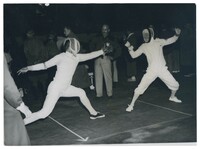 Fahlman vs Stanmore at the 1952 Olympics
Sven Torsten Fahlman of Sweden (left) fencing Charles Joseph Stanmore of Australia (right) during the team foil event at the 1952 Olympic Games in Helsinki, Finland.
-
 February 1955 Esquire Calendar Pin Up
February page of the 1955 Esquire pin-up calendar. The entire calendar features illustrations by George Petty, and the February image depicts a woman wearing a see-through leotard with a red heart on her breast, a fencing glove, and is bending a fencing sword against the ground. A short poem accompanies the image in the top left:
Your Valentine awaits the day
With tender heart and sharp epee.
(In case you'd planned on candy, Sirs,
Get the point - and bring her furs.)
-
 Feminine Fencers : Lady Amateurs Exercising With the Foils
-
 Fence for a Fine Figure
The article describes the fast-paced nature of fencing and the need for precision, highlighting the role of five judges in monitoring tournament bouts. Barbara Cochrane and Mildred Stewart, both national-ranking fencers, are featured demonstrating key fencing techniques. The article outlines their moves, from the formal salute to the parry and riposte, explaining how fencers minimize their target area and maintain balance. It also emphasizes common mistakes, such as attacking with a bent arm, and the effectiveness of a "stop thrust" defense. Additionally, the former metropolitan champion Miss Madeline Dalton and Mrs. Vince, a two-time national champion, are mentioned for their contributions to the sport.
-
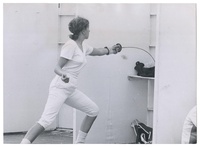 Fencer Demonstrates Skill
Polish fencer uses her foil to slay a cockroach found in her warddrobe.
Transcript on reverse:
"'En El Ombligo'
le clavo el florete esta polaca a una cucaracha que habia hecho de su ropero un campo de entrenamiento."
-
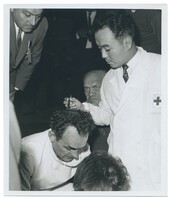 Fencer examined by Medical staff
A Fencer at the 1964 Olympics is examined by medical staff.
-
 Fencer from 1947 Esquire Calendar
Calendar page of the mini 1947 "Esquire Girl Calendar." This Esquire mini calendar was a pocket-sized version of the larger wall calendar produced annually, and this particular February page was cut out of the whole accordion-folded calendar. The original painting of the fencer was painted in early April for the August 1942 edition of Esquire but was replaced by the "George Washington" figure which better suited the wartime fervor.
-
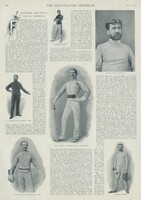 Fencers and Fencing In America
The article discusses the evolution and growing popularity of fencing in America, particularly in New York. Fencing, once a vital skill for gentlemen, has transformed into a fashionable pastime, shedding its violent connotations. The New York Fencers' Club originated from a fencing school established by Captain Hippolyte Nicolas, a French officer. Fencing gained traction despite initial skepticism, with Senac, a French maître d'armes, playing a pivotal role in popularizing it. The text highlights the diverse backgrounds of fencers, including actors and professionals, and notes the charm of perpetual youth that fencing seems to endow its practitioners with. Competitive exhibitions and championships have further fueled interest, with the Amateur Athletic Union organizing contests. The text concludes by suggesting potential changes in championship rules to foster more inclusive and representative competitions. Overall, it paints a picture of fencing as a growing and diverse sport with a rich history and increasing popularity in America, particularly in New York.
-
 Fencers Club Championship
-
 Fencers Club Trio Wins Team Title
-
 Fencers Club Wins Again
-
 Fencers Club Wins John Allaire Trophy
-
 Fencers Club Wins Team Crown
