-
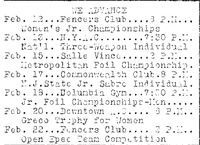 We Advance
-
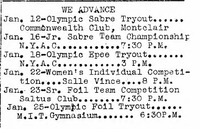 We Advance
-
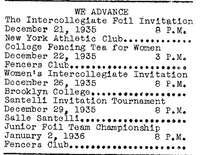 We Advance
-
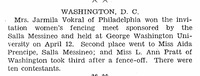 Washington, DC
-
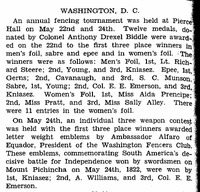 Washington, DC
-
 Washington, DC
-
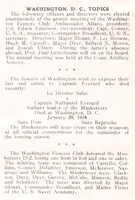 Washington, D. C., Topics
-
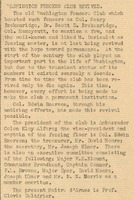 Washington Fencers Club Revived
-
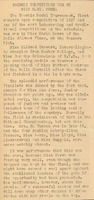 Voorhis Competition Won by Miss Maria Cerra
-
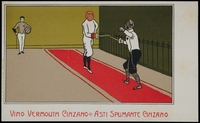 Vino Vermouth Cinzano Postcard
Postcard featuring a fencing instructor wearing a red mask and in a teacher's posture and a student in a blue mask on guard. An unmasked fencer waits in the background, and a wall of foils is to the right of the pair of fencers.
-
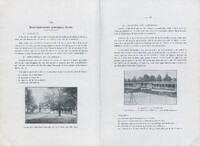 VIII. Renseignements Pratiques Divers
This chapter from "Notice sur l'École Supérieure d'Éducation Physique de Joinville-le-Pont" by Lieutenant-Colonel Labrosse provides information on the school’s facilities, such as laboratories and medical services, which support its educational and research activities. Also included is a list of courses and documents produced by the school.
-
 VIII. Directing : The Conduct of the Bout
-
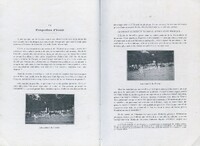 VII. Perspectives d'Avenir
This chapter from "Notice sur l'École Supérieure d'Éducation Physique de Joinville-le-Pont" by Lieutenant-Colonel Labrosse discusses the future prospects of the school, considering both the challenges and opportunities ahead. The school aims to continue its leadership in physical education by adapting to new scientific discoveries and societal needs. The chapter acknowledges the potential for structural changes that could enhance the school’s capabilities, such as transforming it into a national institute. Despite the evolving landscape of physical education, the school remains committed to its mission of advancing the science and practice of physical fitness.
-
 VII. Directing
-
 Vigeant
This chapter from "Amateurs et salles d'armes de Paris" by Adolphe Tavernier profiles Vigeant, a master fencer who became somewhat controversial in the fencing world due to his perceived prickliness and rivalry with Louis Mérignac. Despite these tensions, Vigeant is recognized for his unique talent and style, which set him apart from his contemporaries. Originally, Vigeant did not intend to become a fencing master; however, after a series of personal setbacks, he was drawn into the profession and quickly gained a reputation as one of Paris’s most fashionable and skilled instructors. His fencing style is marked by exceptional finesse and wrist dexterity, though his legwork is considered less strong. Vigeant eventually shifted his focus from active fencing to writing, authoring several significant works on the art of fencing, including La Grammaire de l'escrime and L'Art de l'épée au XIXᵉ siècle, both highly anticipated in the fencing community.
-
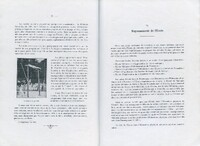 VI. Rayonnement de l'Ecole
This chapter from "Notice sur l'École Supérieure d'Éducation Physique de Joinville-le-Pont" by Lieutenant-Colonel Labrosse highlights the school’s influence and outreach efforts beyond its immediate military context. The school’s instructors frequently conduct lectures and demonstrations for civilian organizations, spreading the principles of physical education throughout France and abroad. The chapter details the numerous conferences and public events where the school has shared its expertise, emphasizing its role in promoting physical education on a national and international scale. The school’s publications and instructional materials are also widely distributed and sought after, further extending its impact.
-
 VI. General Views on Directing
-
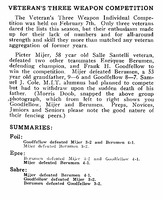 Veteran's Three Weapon Competition
-
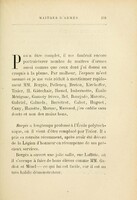 Various Fencing Masters in Paris, 1886
This untitled chapter from "Amateurs et salles d'armes de Paris" by Adolphe Tavernier briefly mentions several notable fencing masters, highlighting their contributions and unique styles.
—Berges, a decorated master, recently retired from École polytechnique and now teaches at his own salle, producing skilled students like his son.
—Pellencq, known for his methodical approach, has trained members of the Orléans family and runs a well-regarded salle near rue Laffitte.
—Kirchoffer, located impasse Royer-Collard, is praised for his gentle yet effective instruction, particularly with beginners.
—Hamel, a former celebrated fencer, is recognized for his expertise in teaching épée, counting among his students several prominent figures.
—Émile Mérignac, who has revitalized his father's salle on rue Monsieur-le-Prince, offers a refined and classical style of fencing, continuing the legacy with a dedicated group of students.
-
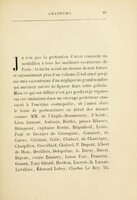 Various Amateur Fencers in Paris, 1886
This untitled chapter from "Amateurs et salles d'armes de Paris" by Adolphe Tavernier reflects on the difficulty of documenting all the top fencers in Paris, noting that many deserving individuals were left out but will be covered in future works. Tavernier provides brief profiles of several skilled fencers, highlighting their unique strengths and characteristics.
—Comte de l'Angle-Beaumanoir is praised for his quick and skillful parries, particularly his mastery of the counter-de-quarte.
—D’Ariste is noted for his elegant and lively style, excelling in ripostes and counter-ripostes.
—Barrol is described as a challenging fencer who uses specially made, nearly unbreakable foils.
—M. Chabrol, president of the Cercle d'Escrime Mimiague, is a highly classical fencer with excellent defensive skills and precise ripostes.
—M. Devillers is recognized for his rapid and powerful attacks that often surprise his opponents.
—Comte Emmery, a left-handed fencer, is particularly skilled in defense and counter-attacks, making him one of the most difficult opponents to touch.
—Gustave Laroze is considered by Mérignac aîné as one of the strongest fencers in Paris, known for his speed and deep understanding of fencing.
—Comte de Lindeman is acknowledged for his finesse and precision in both attack and defense, considered one of the top three fencers in Paris.
—Edmond Blanc is a latecomer to fencing but has quickly caught up, demonstrating passion and skill, particularly in defense.
—M. Passot is compared to Tony Girard, noted for his judgment and quick ripostes despite his physical strength.
—Comte Potocki is recognized for his classical style, precise ripostes, and strong épée skills.
—Roll, also a master painter, is known for his physical strength and judgment, making him a formidable attacker and defender.
-
 Van Buskirk Takes Office
-
 Van Buskirk Prep Won By Miss Treiling
-
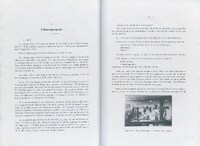 V. L'Enseignement
This chapter from "Notice sur l'École Supérieure d'Éducation Physique de Joinville-le-Pont" by Lieutenant-Colonel Labrosse outlines the educational programs offered at the school, focusing on the instruction of officers and non-commissioned officers in physical education and fencing. The curriculum is designed to equip students with the theoretical and practical skills needed to become effective physical education instructors within the military and civilian sectors. The school is also responsible for ongoing research and experimentation to improve physical education methods, which are incorporated into the teaching process. The chapter highlights the dynamic nature of the school’s curriculum, which is continuously updated to reflect the latest scientific and practical advancements.
-
 V. Judging Foil Touches - Part 4
-
 Utah
