-
 A Foil for Your Figure
-
 A Letter from Arthur Lyon
-
 A Letter from Paris
-
 A Message from Mr. Paul Anspach
-
 A National Intercollegiates
-
 A New Fencing Mask
-
 A New Series of Fencing Articles
-
 A Petition
-
 A Professional on Professionals
The article by Aldo Nadi critiques the shortage of qualified fencing instructors in the U.S., arguing that many self-proclaimed professionals lack proper training. It proposes forming an association to regulate the profession and establishing a university-affiliated academy to train instructors. The article emphasizes fencing as both an art and a discipline essential for national defense, highlighting its role in developing agility, strategy, and mental acuity. It calls for expanding fencing programs in schools with properly trained masters to strengthen both the sport and military preparedness.
-
 A Progressive Move
-
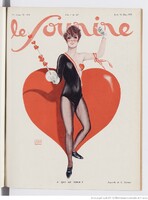 A Qui le Tour?
This image, from the magazine Le Sourire, features a stylish female fencer posed in front of a large red heart. She is dressed in a black fencing outfit with a playful design—a heart emblem on her chest—and holds a fencing foil pierced with small hearts on the blade. Her right arm is raised in an elegant gesture, and she stands confidently in a classic fencing stance. The bright red heart behind her contrasts with her outfit, emphasizing the romantic and whimsical tone of the illustration. The caption, "A qui le tour?" (Whose turn is it?), adds a flirtatious touch to the scene
-
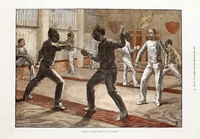 A School of Arms
Illustrated newspaper engraving of a fencing school.
-
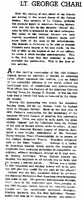 A Sketch of "America's First Fencing Hero" : Lt. George Charles Calnan, U.S.N.
-
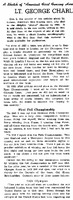 A Sketch of "America's First Fencing Hero" : Lt. George Charles Calnan, U.S.N. [continued]
-
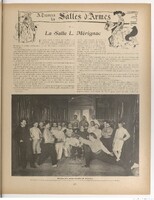 A Travers les Salle d'Armes : La Salle L. Mérignac
This text provides a detailed description of the Salle Mérignac, a prestigious fencing school located in the heart of Paris on Rue Joubert, run by the renowned fencing master Louis Mérignac and his son Lucien. The venue is portrayed as a historical and vibrant center for the art of fencing, decorated with memorabilia, caricatures, and rare prints, creating a museum-like atmosphere. The salle is frequented by numerous fencers, including both amateurs and skilled practitioners, many of whom are named, highlighting the strong community and camaraderie that exists among them.
The narrative underscores Louis Mérignac's illustrious career, noting his undefeated status and his transition from a public fencing master to a more private role as he aged. Lucien Mérignac, described as an extraordinary left-handed fencer with a remarkable lunge, is celebrated for his prowess and success in international tournaments. The description emphasizes the lively and spirited environment of the salle, where friendship and mutual respect among the fencers are central, and where the Mérignac legacy continues to thrive under Lucien's leadership.
-
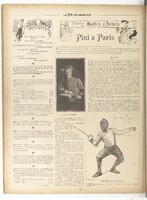 A Travers les Salle d'Armes : Pini à Paris
The article describes the activities of the renowned Italian fencing master, Eugenio Pini, during his time in Paris. It highlights his dedication to the art of fencing and his influence on the sport both in Europe and South America. Pini brought his talented Argentine student, Juan Bay, to Paris, where Bay competed against various French fencers, demonstrating his prowess. The article emphasizes Pini's commitment to fencing as an art rather than a commercial venture, noting that despite financial losses, Pini continues to promote the sport passionately. Pini's rigorous daily training regimen, his establishment of fencing schools in Argentina and Chile, and his efforts to elevate the sport globally are detailed. The article concludes by mentioning a challenge Pini issued for a future competition in Paris, calling for French fencers to prepare and organize teams to meet his challenge.
-
 A Winning Argument from the Losing Side
-
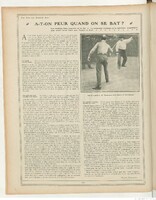 A-t-on Peur Quand on se Bat?
The article, authored by Marcel Boulenger, explores the topic of fear and courage in duels, particularly focusing on swordfights. Boulenger asserts that while true cowardice and extraordinary bravery are rare in duels, nuances exist. He challenges the romanticized views of duels and highlights that the portrayal of duels in the media often lacks accuracy. The author notes that only certain societal circles—literary, political, sporting, and social—are commonly involved in dueling, as it is not a widespread practice among bureaucrats or merchants. Boulenger observes that while some duelists may initially show fear, they often recover composure during the fight. He distinguishes between mediocre and skilled fencers, emphasizing that real courage in a duel is demonstrated by attacking decisively rather than merely defending. The article concludes by criticizing pistol duels as either ridiculous or excessively violent compared to sword duels.
-
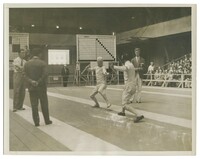 A. Mund and R. Minoli Fencing
A. Mund of Belgium and R. Minoli of Italy opposing each other during the 1932 Olympics in Los Angeles. The scoreboard in the left of the frame is set up as a team event with "3" being the highest score, indicating this photo depicts the team epee competition. Since Italy and Belgium both defeated the third team in their semi-final pool (Mexico), their semi-final match was not held, meaning this photo was taken during the finals. Minoli defeated Mund in this match by 3-1 , and the final team score was Italy 11 and Belgium 5.
-
 A. Rue
This chapter from "Amateurs et salles d'armes de Paris" by Adolphe Tavernier discusses A. Rue, a highly regarded fencing master known for his classical style and impressive skill. Born in Nervieux in 1851, Rue began his fencing journey in the military, quickly distinguishing himself and earning his first master certification at the École de Joinville-le-Pont in 1876. He gained recognition for his participation in public fencing matches and his role as a professor at various prestigious institutions. Eventually, Rue opened his own salle d'armes on Rue Godot-de-Mauroy, which became a popular fencing circle under the leadership of Édouard Lebey. Known for his disciplined technique and exceptional judgment, Rue is praised for his elegance and precision in fencing, despite occasionally holding back on ripostes. He is widely respected both as a teacher and as a performer.
-
 A. Waskiewicz
This chapter from "Amateurs et salles d'armes de Paris" by Adolphe Tavernier profiles A. Waskiewicz, a well-respected figure in the fencing world with Polish origins and a background in finance. Despite his average stature, Waskiewicz is known for his remarkable strength and endurance, though he is sometimes hindered by gout. His demeanor combines both energy and timidity, and he is passionate about defending the principles of fencing. A devoted student of the renowned fencing master Cordelois, Waskiewicz is particularly skilled in attack, executing a variety of strikes with precision and calculated distance. He frequented various fencing salles and is actively involved in mentoring young fencers and organizing events. As vice-president of the Société d'encouragement de l'escrime, he is a central figure in promoting the art of fencing in France.
-
 A.F.L.A. 1939-1940 National Rankings
-
 A.F.L.A. Competitions Held in New York City
-
 A.F.L.A. Competitions Held in New York City
-
 A.F.L.A. Competitions Held in New York City