-
 American Fencing Has a Synonym - The A.F.L.A.
-
 American Fencing Potentialities
-
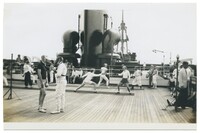 American Olympic Competitors on Board the SS Manhattan
American Olympic competitors practicing on board the SS Manhattan en route to Hamburg for the Olympics.
-
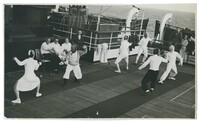 American Olympic Competitors on Board the SS Manhattan
American Olympic competitors en route to Europe and practicing on board the SS Manhattan while other passengers look on.
-
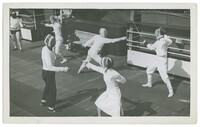 American Olympic Competitors on Board the SS Manhattan
American Olympic fencers practicing on board the SS Manhattan on their way to the 1936 Olympics.
-
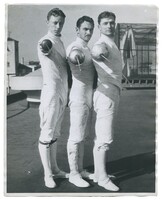 American Olympic Fencers Ted Lorber, Harold Corbin, and Ralph Faulkner
(L to R): Theodore "Ted" Lorber, Harold Corbin, and Ralph Faulkner pose for the camera after being selected for the American Olympic team.
Caption:
"Los Angeles Fencers named for Olympic Team
Ralph Faulkner and Hal Corbin of the Los Angeles Athletic Club and Ted Lorber of the Olympic Club, San Francisco, are the first three members of the American team for the Games to be held in L.S. this summer. The men won the team berths by winni[ng][sic] the three individual championships of the Pacific Coast Fencing Tournament
Photo shows the three winners (left to right). Ted Lorber, Harold Corbin, and Ralph Faulkner"
-
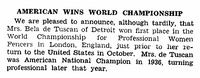 American Wins World Championships
-
 An American School of Foil
-
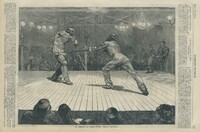 An Assault At Arms - Sword Versus Bayonet
Engraving from Harpers Weekly depicting a fencing bout, or assault at arms, between a fencer armed with a fencing sabre (left) and the other with a fencing bayonet (right). A short article on the assault in includes with the article in the top and bottom left of the page.
-
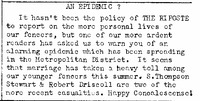 An Epidemic?
-
 An Essay on Sportsmanship
-
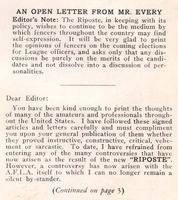 An Open Letter from Mr. Every
-
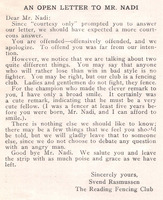 An Open Letter to Mr. Nadi
-
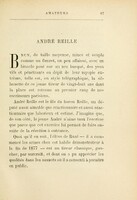 André Reille
This chapter from "Amateurs et salles d'armes de Paris" by Adolphe Tavernier focuses on André Reille, a young and talented fencer who stands out among Parisian swordsmen. Described as slim and agile, with a slight stoop and a keen gaze despite his extreme myopia, Reille is a classical left-handed fencer trained by Ruzé since 1877. His fencing style is both strategic and precise, with a perfect blend of attack, defense, and riposte. While his posture and reach could improve, likely affected by his vision, his hand is exceptionally skilled, allowing him to execute complex maneuvers with finesse. Reille's favorite moves include energetic double-battements followed by a variety of attacks, particularly the feint of the coup droit dégagé. He favors parries in septime and seconde, with effective ripostes, especially in low lines. Beyond fencing, Reille is an accomplished sportsman involved in hunting, horseback riding, and boating, and he is also known for his passionate oratory. A dedicated traditionalist, he is a prominent member of the fencing and sporting community.
-
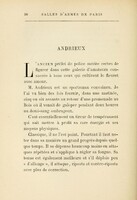 Andrieux
This chapter from "Amateurs et salles d'armes de Paris" by Adolphe Tavernier highlights M. Andrieux, a former prefect of police and a passionate fencer. Andrieux is a dedicated sportsman, often engaging in multiple fencing bouts after a vigorous morning horseback ride. Known for his energetic and physical style, he is not a classical fencer but has shown significant improvement over time, particularly in controlling his aggressive tendencies. His favored attacks include direct thrusts, cuts, disengagements, and one-two combinations, executed with a keen eye for openings. However, his habit of withdrawing his hand can sometimes expose him to counter-attacks. Andrieux, a member of the salle Collin, often fences with M. Sanguinetti, engaging in long and intense matches. His strength and tenacity make him a formidable opponent, especially in épée, where he can fully express his combative nature. His distinctive and expressive appearance has been well captured by the artist Mars in the album L'Escrime à l'Elysée.
-
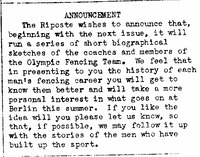 Announcement
-
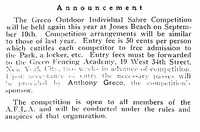 Announcement
-
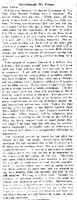 Anonymously We Present
-
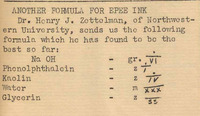 Another Formula for Epee Ink
-
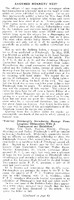 Another Hornets' Nest
-
 Another Point of View
-
 Anthony Scafati Awarded a Certificate of Merit
-
 Antoine d'Ezpeleta
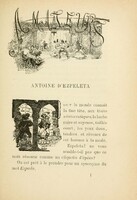
This chapter from "Amateurs et salles d'armes de Paris" by Adolphe Tavernier focuses on Antoine d'Ezpeleta, a distinguished fencer with aristocratic features and a reputation for his exceptional speed and elegance in fencing. The chapter delves into his Basque origins, noting that while his name suggests nobility, it actually refers to a type of plant, symbolizing the deep roots of his family. Ezpeleta, trained by the renowned fencing master Cordelois, is celebrated for his nearly unbeatable attacks and precise technique. Although he has retired from public dueling, his expertise in fencing and matters of honor is still widely respected. The chapter concludes by highlighting his wisdom, courtesy, and bravery, which earned him high esteem during the Franco-Prussian War.
-
 Antonella Ragno wins Bronze
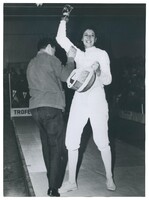
Antonella Ragno of Italy wins Bronze in individual foil at the 1964 Olympics. Text on back of photograph details her Olympic history (including her future 1972 gold medal win, indicating the information was added at a later date).
-
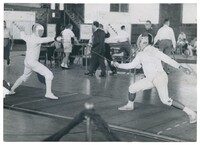 Antonio Almada Félix and Juan Botella Fencing
Juan Botella (of Mexico; seen at left) fences Antonio Almada Félix (of Mexico; seen at right) possibly for purposes of warming up. Antonio Almada Félix competed in the Men's Individual Epee competition and ranked first in Modern Pentathlon. Juan Botella competed in diving.
Caption on reverse:
BUSCAN MEDALLAS
Juan Botella –izquierda– y Antonio Almada Felix tuvieron magnificas actuaciones en la jornada de ayer correspondiente a los Juegos Olimpicos. Almada se clasifico en primer lugar en pentathlon moderno y Botella se coloco en tercer lugar en trampolin.