-
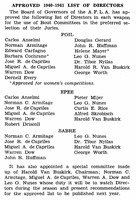 Approved 1940-1941 List of Directors
-
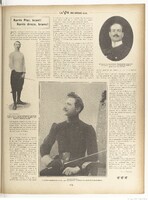 Après Pini, bravi! Après Greco, bravo!
The article describes the significance of Paris as a hub for international sports, particularly fencing, where champions from various countries seek recognition. The focus is on the visits of two renowned Italian fencers, Pini and Agesilao Greco, who came to Paris for fencing demonstrations. Greco, known for his graceful style, introduced his younger brother, Aurelio, who is set to take over his fencing school in Rome. The narrative also touches on past tensions between Greco and a French fencer, Chevilliard, which have since been resolved. Additionally, it mentions a duel involving Bruneau de Laborie, a journalist, and Kirchhoffer, a fencing master, sparked by a critique of Pini's matches. The duel ended with Kirchhoffer lightly wounded.
-
 Archibald and von Puttkammer Fencing Foil
Nancy Archibald (Canada; pictured at left) fencing Hilda von Puttkammer (Brazil) in the women's individual foil event at the 1936 Olympic Games held inside the Haus des Deutschen Sports in Berlin.
Starting from position three, the left-side scoreboard lists competitors (from top to bottom): ???, Berit Granquist (Sweden), Helene Mayer (Germany), Hilda von Puttkammer (Brazil), and Adèle Christiaens (Belgium).
Starting from position two, the right-side scoreboard lists competitors (from top to bottom) Ulla Barding-Poulsen (Denmark), Hedwig Wilhelmine Haß (Germany), Aileen Thomas (Canada), Suat Fetgeri Aşeni Tarı (Turkey), Ingeborg Scheel (Switzerland), and Thea Kellner (Romania).
Caption on reverse:
"Olympiade 1936!
In der Halle des Sportforums begannen am Dienstag die Florett-Fechterinnen mit den Vorkampfen:
---
U.B.z. aus dem Gefecht der Kanadierin Nancy Archibald (links) gegen die Brasilianerin Hilda von Puttkammer"
-
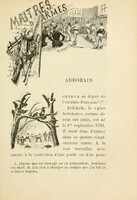 Ardohain
This chapter from "Amateurs et salles d'armes de Paris" by Adolphe Tavernier pays tribute to Ardohain, affectionately known as "père Ardohain," a revered figure in French fencing who passed away at the age of 91. Born in 1794, Ardohain began his fencing career after serving in the military, where he fought in the Battle of Hanau in 1813. He became a master of the art, holding positions as a master-at-arms in various regiments and later teaching at prominent Parisian salles, including Pons and Bertrand. Known for his strong defensive skills, particularly his powerful second parry, Ardohain was more of a defensive fencer than an attacker. Despite his advanced age, he remained active, crafting beautifully balanced foils regarded almost as works of art. Respected for his integrity and disciplined lifestyle, Ardohain's life was marked by a deep commitment to honor and the art of fencing, leaving a lasting legacy in the fencing community. His humor and wisdom endeared him to many, making him a beloved figure in the sport.
-
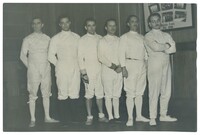 Argentina's 1952 Olympic Fencing Team
Argentina's fencing team photo. The team consisted of (not in photographic order) Félix Domingo Galimi Gherardi, Fulvio Galimi Gherardi, Santiago José Massini Gochetti, José María Rodríguez Roches, and Eduardo Sastre.
Caption:
Una performance de singular merito realizaron los floretistas argentinos. En la primera serie vencieron a Rusia y posteriormente superaron a Hungria y Alemania, para tropezar luego con EE. UU.
[...]ron en el torneo de seleccion para los Juegos Olimpicos realizado ayer en Gimnasia y Esgrima[...]
Translation:
A performance of singular merit carried out by the Argentine fencers. In the first series they defeated Russia and later they surpassed Hungary and Germany, to then run into the USA.
[...]ron in the selection tournament for the Olympic Games held yesterday in Gymnastics and Fencing[...]
-
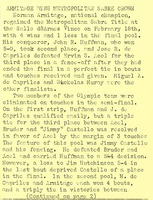 Armitage Wins Metropolitan Sabre Crown
-
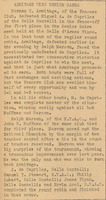 Armitage Wins Senior Sabre
-
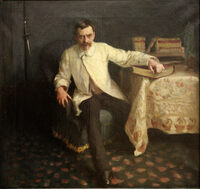 Arsène Vigeant
Portrait of Maître d'armes Arsène Vigeant painted by the American painter John Singer Sargent.
From "Les insolites du musée de la Cour d’Or de Metz : un portrait pour sceller l’amitié," Le Republican Lorrain, August 20, 2016 [Link]:
"Né à Florence en 1856 d’un père américain expatrié en Europe, Sargent a fait les Beaux-Arts à Paris avant de partir en 1886 à Londres pour devenir le portraitiste de la bonne société anglaise. « Il a rencontré Arsène Vigeant entre 1874 et 1886 à Paris par l’entremise de son professeur, le portraitiste Carolus-Duran, qui, lui, était l’élève en escrime de Vigeant », explique Claire Meunier. Né à Metz en 1842, Arsène Vigeant est un maître d’escrime renommé qui fréquente le Tout-Paris aristocratique et bourgeois de l’époque. En 1873, il devient le professeur attitré à Paris du Cercle de l’Union artistique avant de diriger la salle d’armes du Figaro. « En 1885, au moment où Sargent réalise son portrait, Vigeant connaît un tournant dans sa carrière. Suite à un désaccord avec Louis Mérignac, une autre star de l’escrime, il a décidé de quitter le Cercle de l’Union artistique pour devenir historien de l’escrime et collectionneur. C’est ce que Sargent montre dans son œuvre. Il relègue l’épée à l’arrière-plan et met l’accent sur les livres reliés sur la table et rangés sur les étagères. On distingue aussi à droite du tableau une petite statuette en bronze d’une minerve antique du IIe s. » Sargent offrira et dédicacera le tableau à son ami. En 1916, en pleine Guerre mondiale, Vigeant, lui, écrira dans son testament qu’il lègue ce tableau « au musée de Metz, ma ville natale », à condition qu’elle « soit redevenue française ». En 1920, la toile entrera au musée."
-
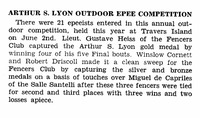 Arthur S. Lyon Outdoor Epee Competition
-
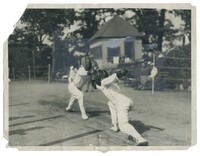 Arthur St. Clair Lyon and R. Clapp fencing at Travers Island
 to determine who will represent the United Sates at the 1920 Olympics in Antwerp, Belguim.
Date stamp: June 28 1920
Tape: NAVAL ENSIGNS BEING - OUT FOR OLY[MPIC] GAMES AT TRAVIS ISL[AND] [sic]
Caption: Arthur S. Lynon [sic] and R. Clapp engaged in a fencing bout at Travis Island [sic]. The ensigns were tried out to ascertain who would represent the U.S. in the olympic games in Antwerp, Belgium. (Copyright Keystone View Company)
Stamp:
Keystone View Co Inc. of N.Y.
142 West 23rd St., N.Y.C.
Credit must be given for you use only.
-
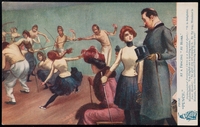 At a Fencing "At Home"
Postcard with fencing scene and written joke: "Distinguished Foreigner (hero of a hundred duels): 'It is delightful, Mademoiselle. You English are a sporting nation.' Fair Member: 'So glad you are enjoying it. By the way, Monsieur le Marquis, have they introduced fencing into France yet?'" Signature "Oilette" on bottom left of illustration. Back of card details the jokes origin from "Punch". Printed in England by "Raphael Tuck & Sons’ 'OILETTE' [Regd.]". Postcard number 9188. Publishers proclaim to be "ART PUBLISHERS TO THEIR MAJESTIES THE KING & QUEEN".
-
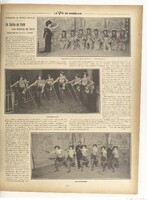 Au Casino de Paris : Les Pantins de Paris : Ballet-Revue de P.-L. Flers
The article discusses "Les Pantins de Paris," a ballet-revue performed at the Casino de Paris, a venue well-known for its association with athletic events like the world wrestling championship. The revue, written by P.-L. Flers—a pseudonym used by Léon Pierre Édouard Pujol—prominently features sports, making it particularly appealing to Paris' athletic community, including those involved in fencing and other physical sports. Flers, recognized for his contributions to sports as a founder of the Racing Club and a former football captain, infuses his passion for athletics into the narrative, especially in an act set at the Femina Sporting Club. This fictional club highlights women participating in various sports such as fencing, boxing, and football, reflecting the increasing role of women in athletics. The production is meticulously staged by M. Borney, who is praised for his hands-on approach, with choreography and direction from experts in various sports, enhancing the performance's authenticity and appeal.
-
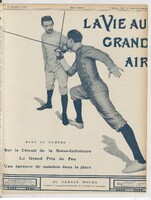 Au Cercle Hoche
Cover of the magazine La Vie au Grand Air, dated February 9, 1907. It features a fencing scene with two men—Jean-Joseph Renaud and Gaudin from Cercle Hoche—in fencing attire, engaged in a bout with foils. No accompanying article found in the issue.
-
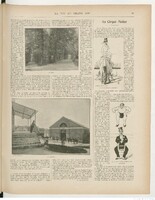 Au Cirque Molier
The article describes a charitable event at M. Molier's amateur circus, which has been renovated following a fire and now hosts a variety of performances. Located on rue Benouville, the circus features sports and artistic displays, including equestrian shows, fencing, boxing, and gymnastics. M. Molier's aim is to entertain friends and promote physical fitness, despite some criticism for involving the nobility in such activities. Weekly intimate training sessions include weightlifting, juggling, and fencing, with M. Molier showcasing refined horseback riding.
-
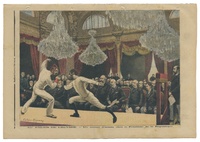 Au palais De L'elysée : Un Assaut d'Armes chez le Président de la République
The article describes a fencing event hosted by President Félix Faure at the Élysée Palace, emphasizing his enthusiasm for physical exercises, particularly fencing. The event, attended by prominent figures and presided over by military officials such as General Lewal and General Gervais, featured several duels between skilled fencers, including military officers and nobility. The most notable matches included bouts between individuals like Gaston Guignard and Merlin, and the Comte de Lendemann and Chevillard. The event was considered a great success, reflecting well on French fencing and leaving attendees impressed by the president's gracious hospitality. Guests received a beautifully illustrated program, designed by Régamey, provided the illustration for the article.
-
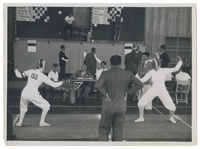
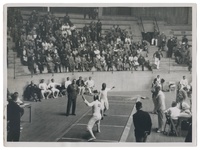 Audience and Fencers Inside the Haus des Deutschen Sports
Interior view of the Haus des Deutschen Sports in Berlin during the men's team foil event of the 1936 Olympic Games.
Caption on reverse:
"Olympiade 1936!
In der Deutschlandhalle begannen am Sonntag die Mannschafts kampfe im Florett
---
U.B.z. Blick in die Halle wahrend der Kampfe der Fechterinnen"
-
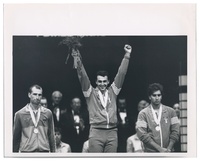 Award Ceremony for Mens Foil Individual
 event at the 1984 Olympic Games. From left to right: Matthias Behr (West Germany, 2nd place), Mauro Numa (Italy, 1st place), and Stefano Cerioni (Italy, 3rd place).
-
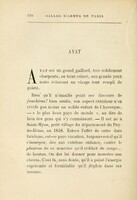 Ayat
This chapter from "Amateurs et salles d'armes de Paris" by Adolphe Tavernier profiles Ayat, a robust and energetic fencing master known for his formidable skills. Born in Saint-Myon, Auvergne, in 1848, Ayat's military career began in the 27th Regiment of the Line, where he developed his fencing abilities under the tutelage of Collas. Despite a rocky start, Ayat's dedication led to his recognition as a highly skilled fencer, eventually becoming a professor at the prestigious fencing club on Rue d'Anjou. Ayat's teaching style is characterized by relentless attacks and quick, precise ripostes, earning him a reputation as one of the most formidable fencers of his time. His students include notable figures such as the Comte Albert de Dion and Baron de Noirmont. A left-handed fencer like his peers Ruzé père and Hottelet, Ayat's unmatched energy and speed make him a challenging opponent in any bout.
-
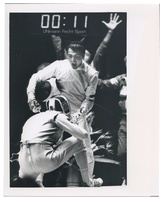 Behr Defeats Pietruszka in the Finals
Matthias Behr (West Germany, depicted in back) yells happily after he won the bout against Frédéric Pietruszka (France, depicted in foreground) in the finals of the men's individual foil event at the 1984 Olympic Games. Behr won silver in this event.
-
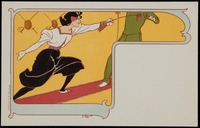 Belgian Fencing Postcard
Postcard featuring a left handed female fencer thrusting to her opponent's chest, and specifically to a red heart on his jacket. Both fencers hold figure eight french foils, are on a red piste, and behind them on the wall are crossed swords and two masks.
-
 Belgian Fencing Postcard
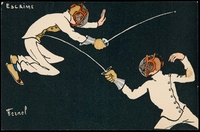
Postcard featuring caricatures of fencers against a black background. "Escrime" printed in the top left and the signature of the artist "Fernel" in the bottom left.
-
 Berretrot et Lemoine
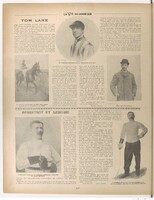
The article discusses two prominent figures in the world of fencing, Berretrot and Lemoine, highlighting their contributions and roles within the military and fencing community. Berretrot, a distinguished fencing master and former professor at the Cercle Militaire, was celebrated for his loyal service in the army, which earned him the Légion d'Honneur. This honor was awarded to him during a significant fencing event, marking his departure from the sport. Lemoine, one of the esteemed instructors from the Joinville school, was selected to succeed Berretrot as the director of the fencing hall at the Cercle Militaire. Although some members of the Cercle Militaire preferred Berretrot's student, Sergeant Rossignol, the selection criteria required the candidate to hold the rank of adjutant, which led to Lemoine's appointment. The article concludes by wishing Lemoine success in his new role, noting that his duties will require him to participate more actively in public fencing matches.
-
 Biddle Trophy Retired by Barringer
-
 Board of Governors Nominees
-
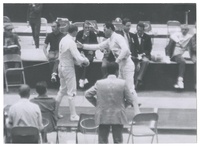 Bout at the 1968 Olympics
Image of a fencing bout at the 1968 Olympics
