-
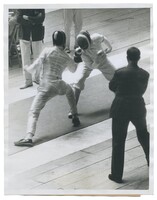 Bout Between E. Kofoed-Hansen vs. G. Pessina
Erik Kofoed-Hansen and Giorgio Pessina pictured fencing foil during a 1932 Olympic bout.
Caption on reverse:
Italy's swordsmen triumphed over the Danish team 12-4 in the team fencing jousts at the Los Angeles Olympic Games, but in this particular battle, Erik Koford-Hansen [sic], famous swordsman won over Giorgio Pessini [sic], Italy. (Fencing events of the Xth Olympiad in Los Angeles.)
-
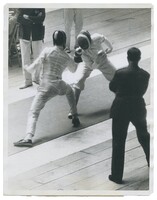 Bout Between E. Kofoed-Hansen vs. G. Pessina
Erik Kofoed-Hansen and Giorgio Pessina pictured fencing foil during a 1932 Olympic bout.
Caption on reverse:
Italy's swordsmen triumphed over the Danish team 12-4 in the team fencing jousts at the Los Angeles Olympic Games, but in this particular battle, Erik Koford-Hansen [sic], famous swordsman won over Giorgio Pessini [sic], Italy. (Fencing events of the Xth Olympiad in Los Angeles.)
-
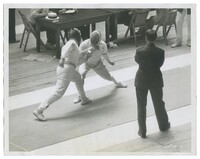 Bout Between H. Alessandroni vs J. Piot
Hugh Alessandroni and Jean Piot pictured fencing foil during the 1932 Olympic games.
Caption on reverse:
Hugh Allesandroni [sic], American foilsman, pictured winning from Jean Piot, French ace, 5-2 in the American-French team competitions of the Olympic Games at Los Angeles.
-
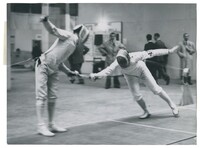 Bout between Nils Sjöblom and Andrew Boyd
Nils Sjöblom of Finland (right) and Andrew Boyd of the United States of America (left) fence at the Palace of Engineering during the 1948 Olympics.
Caption:
"Fencing, at the Palace of Engineering Wembley today. Sjoblom (Finland) on right in action today in his match, which he won, with Boyd (USA). Note the wires that electrically record all hits that are made"
-
 Boyd Wins "Duff Swords"
-
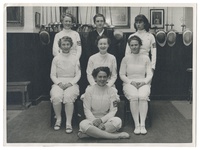 British Women's World Championship Team
Likely members of the British women's word championship team, possibly at Salle Bertrand in London.
-
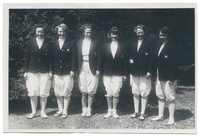 British Women's World Fencing Championship Team
British World Fencing Championship team in The Hague, Netherlands.
-
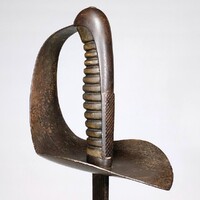 Broqua & Scholberg Fencing Sabre
Fencing sabre with ribbed wood grip and plate guard. Blade is fullered the full length on both sides and the point is rounded. Peened hilt. "Broqua & Scholberg" makers mark on the blade's forte.
-
 Bulletin From Philadelphia
-
 Caïn
This chapter from "Amateurs et salles d'armes de Paris" by Adolphe Tavernier describes Caïn, a skilled fencing master known for his disciplined military background and refined technique. Having served in the French army and participated in significant battles, Caïn transitioned into a respected fencing instructor. His teaching style combines patience, methodical instruction, and an engaging approach that motivates students. Though he prefers to stay out of public matches, his expertise is well recognized among those who train with him. Caïn's fencing is characterized by precise attacks, rapid disengages, and strategic parries, making him a formidable opponent. Tavernier highlights his dedication to continuous improvement, even at the age of forty, and encourages him to seek greater recognition. The chapter also mentions the notable fencers who have trained in Caïn's salle, emphasizing its prestigious reputation.
-
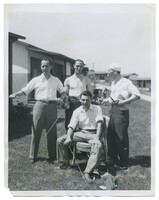 Canadian Fencing Team Posing at the Olympic Village
The Canadian Fencing Team poses at the Olympic Village in Los Angeles. Seated is Henri Delcellier, left to right above him is: Bertram William Markus, Patrick Farrell, and Ernest Alfred Dalton.
Caption:
Members of the Canadian Fencing Team check over their equipment in the Olympic Village in Los Angeles. Seated is H.A. Delcellier, Manager. Left to Right: B. W. Markus, P. Farrell, and E.A. Dalton
-
 Canadian National Fencing Championships
-
 Cantor Scores Brilliant Victory in Sabre
-
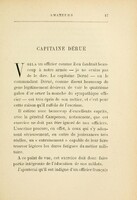 Capitaine Dérué
This chapter from "Amateurs et salles d'armes de Paris" by Adolphe Tavernier profiles Capitaine Dérué, an exemplary officer who is deeply passionate about both his military career and the art of fencing. Described as an ideal officer, Dérué is a strong advocate for integrating fencing into the training of French soldiers, believing it provides essential physical conditioning and discipline. Tall, with a commanding presence and a military demeanor, Dérué is known for his tireless energy and dedication to fencing. He frequently practices at the salle Mimiague and the Élysée, where he impresses with his stamina and relentless attacking style.
Although his defensive skills are solid, Dérué excels in offensive techniques, particularly rapid sequences of feints and thrusts that overwhelm his opponents. He is also recognized for his contributions to the École d'escrime de Joinville-le-Pont, where he played a significant role in implementing reforms that elevated the status of fencing instructors within the military. Additionally, he has written influential works on cavalry fencing, advocating for the use of thrusts over slashing techniques in combat. Capitaine Dérué's dedication to fencing has earned him a respected place in the military, where his efforts have significantly impacted the development of fencing as a critical military skill.
-
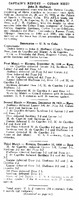 Captains Report - Cuban Meet
-
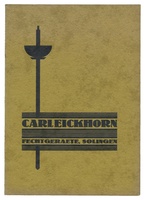 Carl Eickhorn Fechtgeraete Catalog
Carl Eickhorn (Solingen, Germany) catalog covering their complete line of fencing equipment.
-
 Carol Alessandroni Wins Fish Competition
-
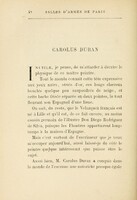 Carolus Duran
This chapter from "Amateurs et salles d'armes de Paris" by Adolphe Tavernier focuses on Carolus Duran, a renowned painter who is equally celebrated for his skills in fencing. Known for his expressive features and vibrant presence, Duran, often referred to as the "French Velazquez," is as passionate about fencing as he is about painting. He served as the president of the École d'Escrime française and has developed a reputation in the fencing community that rivals his fame in the art world. Duran began fencing seriously under the tutelage of Vigeant, who helped refine his natural, albeit irregular, style into a more disciplined and strategic approach.
Duran is known for his defensive skills, with a preference for simple parries that set up precise and powerful ripostes. He is also adept at attacking with sequences like the one-two-three thrusts and disengagements, often executed with speed and finesse. His strong, yet flexible, hand and sharp judgment make him a formidable opponent. Beyond fencing, Duran is a multifaceted sportsman, skilled in horseback riding and music, and remains a respected figure for his ability to keenly observe and judge the nuances of fencing bouts. His dedication to both fencing and painting has earned him admiration in both fields, blending the precision of an artist with the strategic mind of a fencer.
-
 Casanova Wins Riposte Tourney
-
Castello Fencing Equipment Company
-
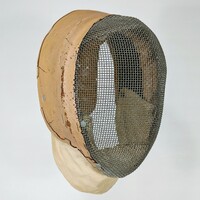 Cavaliers Fencing Mask
Fencing mask with imitation leather on the top and sides of the mask encircling the face. Unpadded canvas bib is removable and attached with snaps. Manufacturer's label on the inside under the right ear.
-
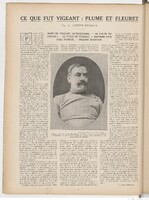 Ce Que Fut Vigeant : Plume Et Fleuret
The article provides a comprehensive overview of Paul-Arsène Vigeant's life and legacy. It details his early life in Metz, his military service and escape during the Franco-Prussian War, and his distinguished career as a fencing master in institutions like Collège Stanislas. Vigeant's prowess with the foil, adherence to the Jean-Louis method, and his role in training notable fencers such as Kirchhoffer are highlighted. The article discusses Vigeant's involvement in notable duels, his literary contributions with monographs on fencing masters, and his membership in the Société des Gens de Lettres. It concludes with his peaceful passing in Beausoleil, underscoring his dual impact as both a skilled fencer and a respected writer within the fencing community.
-
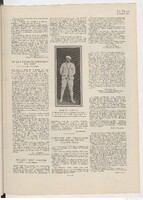 Ce Que Pense le Président du Jury
The article discusses the upcoming significant fleuret match between Lucien Gaudin and Aldo Nadi, focusing on their motivations and expectations. Aldo Nadi, renowned as Italy's undisputed champion, seeks to solidify his victory over Gaudin, despite it being achieved under Gaudin's injury. The match is seen as a chance for Nadi to prove himself against Gaudin's reputation, aided by his personal style and speed compared to his brother Nedo. For Gaudin, the match presents an opportunity to redeem his record from the stain of his previous loss to Nadi. The author, serving as president of the jury, emphasizes the solemn responsibility of ensuring fair play and rule adherence during international matches. The article concludes with a hope that the loser accepts defeat graciously, highlighting the importance of sportsmanship in victory and loss alike.
-
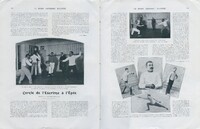 Cercle de l'Escrime a l'Epee - Salle Spinnewyn
Newspaper article about the fencing school of Anthime Spinnewyn with descriptions of the salle d'armes, notable students (including Maurice Maeteilinck, Belgian playwright, poet, and essayist), school culture, and Spinnewyn's technique and teaching approach.
-
 Certificate of Merit
